Thin-liquidity noise.
Thesis
Bull case
Network fundamentals are genuinely strong: stablecoin volume +121% QoQ, ~$4.1B RWA, record developer activity, institutional pilots (DTCC, BNY, WisdomTree, MoneyGram). At -80% from ATH with no protocol inflation and 70% of supply already circulating, any future fee-capture mechanism, ETF product, or institutional XLM reserve requirement would re-rate a deeply compressed asset with a real working network underneath.
Bear case
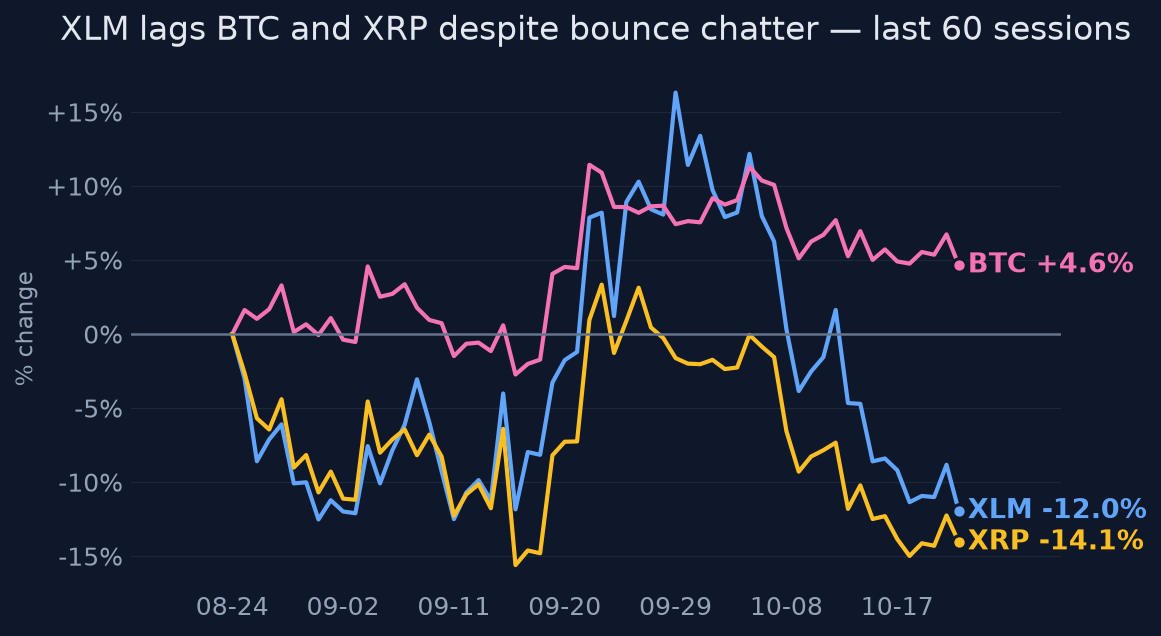
The token captures nothing: $535K annual fees locked away, no staking, no burn, 15,350x FDV/revenue. It trades as a high-beta XRP proxy in a downtrend, -24% relative to BTC over 3m, with ~30B XLM of SDF supply (60% of total) available for discretionary distribution and ~2.5% estimated new supply over 90 days. Thin liquidity (1.8% vol/mcap current snapshot) means downtrends gap lower.
What would change our mind
- If Stellar proposes or implements any fee burn, fee distribution, or staking mechanism, the no-accrual thesis breaks — reassess immediately
- If a spot XLM ETF/ETP files or institutional balance-sheet XLM holdings are confirmed, a real demand channel opens
- If 90d relative strength vs BTC turns positive on rising volume/mcap ratio (>4%), the thin-noise read on the tape is wrong
- If stablecoin supply and TVL keep compounding while price decouples further, the decoupling thesis is confirmed rather than invalidated
Since publication vs BTC · closed horizons are frozen
No price data after the entry date yet.
The full research everything the view rests on
Direct answer to the question asked
Where the edge would come from
What the price assumes
At $6.2B market cap / $8.8B FDV against ~$535K annual network revenue, the market is pricing XLM almost entirely as a payments/RWA narrative beta asset — a levered proxy on XRP and stablecoin-adoption headlines — with no cash-flow anchor.
Why the market may be wrong
If institutional RWA/stablecoin issuers ever needed to hold meaningful XLM for reserves, fees, or bridge liquidity, the accrual story could change — but current evidence shows ecosystem growth (USDC transfers, tokenized assets) structurally bypasses XLM. Conversely, the market may be underpricing the ~30B XLM (60% of supply) SDF discretionary overhang.
The one thing to watch
The decoupling is the story: Stellar posted +121% QoQ stablecoin volume and +75% YoY TVL while the token fell 44% over the same year — the cleanest large-cap proof that L1 adoption metrics and token value can fully diverge when the fee design captures ~0.01% of market cap annually. The variable to watch is not TVL or RWA headlines, it's whether any fee-switch, burn, or institutional XLM-holding requirement ever gets proposed.
Key evidence (7)
- XLM -18.4% 1m, -44.1% 1y, at 0th percentile of 20d range, below 20/50/200d SMAs, 1m z-score -0.96 (CoinGecko/price history, 2026-10-22) — no abnormal up-move exists to explain
- Current 24h volume $114M vs $6.18B mcap (1.8%), a snapshot as of 2026-10-22 (CoinGecko) — thin for a top-20 asset and the best available proxy for tape thinness; exchange-level volume for the Oct 19-21 bounce window itself was not obtainable
- Stellar fees: $1,390/24h, ~$535K/yr; FDV/annualized revenue ~15,350x; fees go to a locked pool — no burn, staking yield, buyback, or governance rights (DefiLlama; Stellar docs)
- Q3 2026 stablecoin transfer volume $25.1B, +121% QoQ; tokenized RWA ~$4.1B, +548% YoY [stellar.org, self-reported, T4]; TVL $231M, +74.7% 1y but -10.3% 30d (DefiLlama)
- 60d correlation to XRP 0.81 (beta 0.94); relative strength -13% vs BTC and -4.1% vs XRP over 1m (quant analysis)
- SDF holds ~30B of ~50B total XLM (~60%) as discretionary distribution overhang; secondary estimate of ~884M XLM entering circulation over 90d [T3, unverified against primary]
- Protocol 30 'Bell' testnet vote Nov 3, 2026 and mainnet vote Nov 23, 2026 (post-quantum signatures) — narrative-positive, no demonstrated price impact [T4]
Catalysts and risks
Catalysts
- Protocol 30 'Bell' testnet vote, Nov 3, 2026
- Protocol 30 mainnet vote/activation, Nov 23, 2026
- Reported Oct 21 digital-commodity/SEC clarity initiative (unconfirmed, T4 only)
- Ongoing SDF distribution pace (~884M XLM estimated over 90d)
- Any future proposal for fee burn/distribution or an XLM ETP/ETF filing
Risks
- SDF discretionary selling from its ~30B XLM reserve
- Continued bleed as XRP proxy if payments narrative fades
- Thin liquidity amplifying downside moves
- Ecosystem growth headlines repeatedly failing to translate into token demand
- Upgrade execution risk around Protocol 30 for exchanges/wallets
What to watch
- Any governance/foundation discussion of fee-pool utilization, burn, or staking
- Volume/market-cap ratio — sustained readings above 3-4% would indicate real participation vs the current 1.8% snapshot
- XLM/BTC and XLM/XRP relative strength over 30-90d
- SDF wallet distribution pace vs the ~884M/90d estimate
- Nov 3 and Nov 23 Protocol 30 vote outcomes and any exchange disruption
- Stablecoin supply on Stellar (~$935M) and TVL ($231M) trend after the recent -10% 30d decline
Market snapshot when the call was made 2026-10-22
Price
| Return 1w | -3.7% |
| Return 1m | -18.4% |
| Return 3m | -6.2% |
| Return 6m | -0.5% |
| Return 1y | -44.1% |
| From 52-week high | -46.8% |
| Realized vol, 20d | 54.7% |
| BTC 3m / 1y | +23.1% / -24.9% |
| ETH 3m / 1y | +23.3% / -38.4% |
| QQQ 3m / 1y | +4.8% / +18.6% |
Technicals
Verifier notes REVISE · opinion revised once
Unsupported claims
- Direct-answer sentence asserts the Oct 19-21 bounce 'happened on $114M daily volume against a $6.2B market cap (1.8% vol/mcap)'. The $114M/1.8% figure is the current 24h snapshot as of 2026-10-22 (CoinGecko), not measured volume during the Oct 19-21 bounce window. The planner digest explicitly lists 'exact intraday volume profile around Oct 19-21' as unknown ('couldn't get exchange-level volume vs. historical average; 1.8% vol/mcap is the best proxy'). The opinion presents this proxy as a direct observation of the bounce, which the evidence does not establish.
Corrections applied
- Reword the direct-answer sentence to attribute the volume figure to the current snapshot rather than the bounce window, e.g.: 'the only bounce (~4.5% over ~46 hours around Oct 19-21) has already been erased by today's -5%, and current liquidity is thin — $114M 24h volume against a $6.2B market cap (1.8% vol/mcap) — the best available proxy for a thin tape, though exchange-level volume for the bounce window itself was not obtainable.' No other figure changes: all other numbers (returns, fees, 15,350x FDV/revenue, 0.81 XRP correlation, relative strength, SDF ~30B/60% overhang, ~884M/90d estimate, Protocol 30 dates) check out against the evidence, T4-sourced ecosystem metrics are properly flagged in key_evidence, and view NO_CLEAR_EDGE at conviction 3 is band-consistent.
Sources (8 · T1 = primary filings)
- T4https://stellar.org/blog/foundation-news/q1-2026-execution-at-network-scale
- T4https://www.bitget.com/amp/news/detail/12560605989180
- T4https://stellar.org/solutions/stablecoins
- T3https://coinmarketcap.com/top-stories/6ad783c56b70f57fdc586024/
- T4https://cryptonewsland.com/stellar-rwa-market-reaches-3-54-billion/
- T4https://www.tokenpost.com/news/technology/35369
- T4https://stellar.org/blog/foundation-news/q2-2026-what-stellar-was-built-for-has-arrived
- T4https://coinfomania.com/stellar-reveals-99-99-uptime-and-record-developer-engagement/
Want a fresh look at XLM, or another name?
Queue a new deep-research run. Published to the feed when done.
Automated research opinion, published as-is on Oct 22, 2026. Not personalised advice. Figures use end-of-day closes.