No clear edge yet.
Thesis
Bull case
The bearish repricing may have overshot because estimates rose into the selloff and only a minority of RPO must convert near term. If Oracle funds FY27 without a credit spiral, customer prepayments blunt reported capex, the $20B ATM clears the overhang, and OpenAI/Stargate milestones stay intact, the stock can re-rate violently from ~18x FY27 EPS because the marginal proof is credit compression rather than heroic revenue growth. A confirmed investment-grade path plus stable FY27 EPS would make the current price look like distressed pricing for a still-growing franchise.
Bear case
The equity may be correctly de-rated because the largest customer relationship is press-reported at ~$300B while OpenAI’s press/secondary-reported economics—~$25B annualized revenue and heavy burn, per T4 summaries the bundle itself flags as unverified—may not support that scale without continued external capital and explosive growth. Oracle must fund roughly $70B net FY27 capex after a -$23.7B FCF year, with only part of the ~$40B need clearly identified and real dilution from the ATM program; CDS near ~200bp and a negative Moody’s outlook say creditors are already charging for this risk. If OpenAI renegotiates, S&P/Fitch/Moody’s actions worsen, or FY27 EPS proves vulnerable to GPU depreciation and share count, downside can be convex because the technical trend is still bearish and the next dated earnings checkpoint is months away.
What would change our mind
- Bearish/no-edge view is invalidated if ORCL 5y CDS compresses decisively back toward ~100-125bp while FY27 revenue/EPS consensus remains near $90B/$8.05 and the ATM completes without accelerating dilution—evidence the issue was multiple compression, not solvency.
- Bullish re-rate is invalidated if OpenAI formally downsizes/cancels/delays the Oracle commitment, misses payments, or Oracle cuts FY27 guidance/RPO conversion expectations.
- Bullish case is invalidated if two or more rating agencies move toward high-yield, CDS sustains >300bp, or Oracle announces funding terms materially worse than the disclosed balanced debt/equity plan.
- Neutral stance hardens if FY27 EPS estimates fall >10% while the stock remains below the 50d average, implying estimate risk has joined credit risk.
Since publication vs SPY · closed horizons are frozen
The full research everything the view rests on
Direct answer to the question asked
Where the edge would come from
What the price assumes
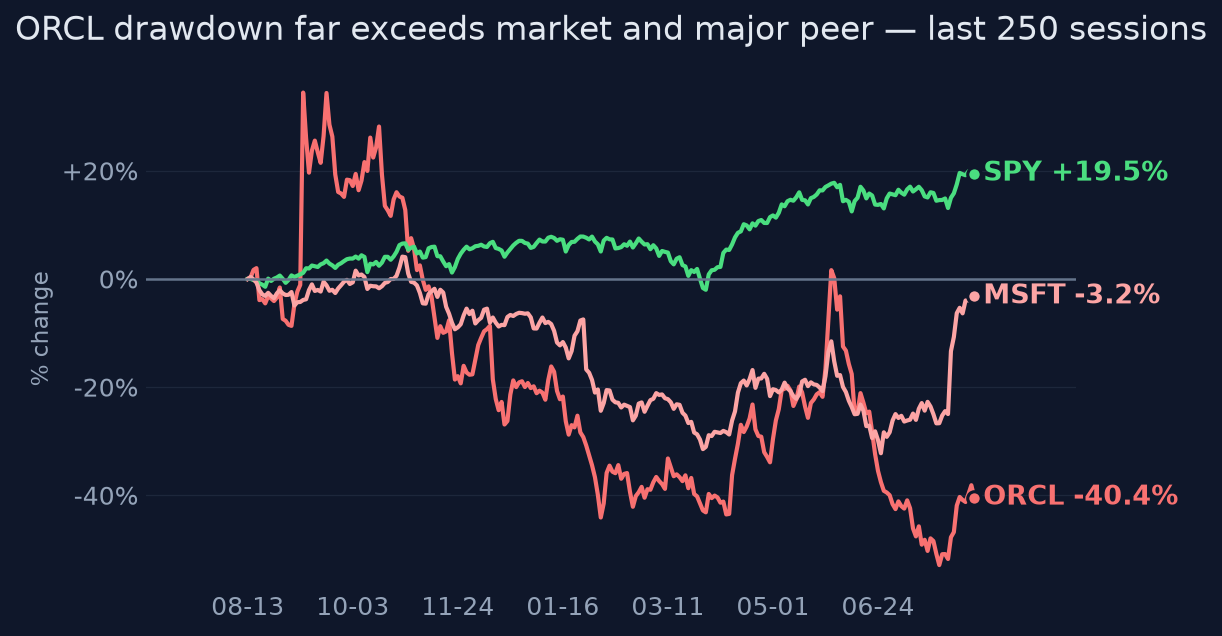
The price appears to assume a high probability of some combination of material equity dilution, higher funding costs/rating pressure, and a haircut to OpenAI-linked backlog. It is not merely pricing slower cloud growth: MSFT is roughly flat over 1 year while ORCL is -41.8%, and ORCL underperformed SPY by ~63 percentage points over 1 year, indicating idiosyncratic credit/counterparty risk.
Why the market may be wrong
It may be too pessimistic if only ~12% of RPO needs to convert in FY27, customer prepayments/timing effects absorb part of capex, no new calendar-2026 debt holds, Stargate remains on schedule, and Google/Gemini plus other wins diversify demand; then CDS compression could drive a sharp multiple re-rate even without estimate upgrades. It may be too optimistic if OpenAI’s press/secondary-reported ~$25B annualized revenue/run-rate and heavy burn cannot fund a reported ~$300B commitment, the remaining FY27 funding beyond the $20B ATM is unclear, and depreciation plus dilution make $8.05 FY27 EPS less credible.
The one thing to watch
Stop watching cloud revenue beats and start watching Oracle 5-year CDS, ATM issuance pace, and OpenAI financing cadence: if FY27 EPS estimates hold while CDS compresses back toward ~100bp, the drawdown was multiple compression; if beats keep arriving but CDS stays near ~200bp, the market is saying equity is junior to the funding problem.
Key evidence (9)
- Price/technicals as of 2026-08-11/12: last close $145.48; -41.82% 1y, -55.69% below 52w high, max 1y drawdown -65%, 20d realized vol 66.1%; SPY +20.93% 1y and MSFT -3.49% 1y in comparison set [computed price data].
- Q4 FY26 reported 2026-06-10: non-GAAP EPS $2.11 vs ~$1.96 expected; revenue $19.18B vs ~$19.10B expected; Oracle called it record Q4/FY26 and kept FY27 revenue guide around $90B with non-GAAP EPS around $8.05 [T1 Oracle IR; T3 CNBC 2026-06-10].
- Estimate direction: FY27 revenue guidance was raised to ~$90B from ~$89B on 2026-03-10; analysts had been lower before that update, and post-June consensus clustered near $89-90B revenue and ~$8.01-8.05 EPS [T3 CNBC; T3/T4 estimate pages, mixed quality].
- Backlog/RPO: reported RPO rose from $455B in FQ1 FY26 to $523B in FQ2 and $638B by Q4; Reuters-linked reporting says Oracle expects ~12%, or ~$76.6B, to convert in FY27; ~$300B is press-attributed to OpenAI and not filing-verified in the bundle [T2 Reuters; press attribution caveat].
- Funding/financials: FY26 capex $55.66B exceeded the prior ~$50B target; FY26 FCF was -$23.7B; FY26 financing was $43B debt + $5B equity; FY27 plan is ~$40B raise including a $20B ATM equity program, with Oracle saying no additional debt in calendar 2026; stock fell ~11% on the raise/cash concerns [T2 Reuters 2026-06-10; T1 Oracle financing release; T3 CNBC 2026-06-11].
- FY27 capex: net cash capex guided around $70B, with roughly $20-25B of customer prepayments/timing effects that could make reported capex higher than the net cash figure [T1/T3/T4 mix; treat exact prepayment split as guidance-framed].
- Credit: Bloomberg reported 2026-07-20 that Oracle credit risk hit a near-18-year high; bundle puts 5y CDS around 198-203bp in July; Moody’s negative outlook is referenced; a claimed S&P cut to BBB- appears only in uncorroborated T4 material and is unconfirmed [T2 Bloomberg; T4 flag].
- OpenAI counterparty: CNBC reported 2026-04-28 that OpenAI reportedly missed revenue targets, triggering ORCL/chip-stock weakness; bundle cites ~$25B annualized OpenAI revenue/run-rate and Q1 2026 $5.7B revenue/$3.7B burn from lower-tier summaries, so collectability of a ~$300B commitment is an assumption, not a verified fact [T3 CNBC; T4 caveat].
- Offsets/catalysts: CNBC reported March 2026 Stargate’s eight OpenAI sites were ‘on track and on schedule’ per a source; no evidence of OpenAI contract cancellation was found; Oracle-Google Cloud Gemini expansion on 2026-07-30 coincided with a +9.22% move on 2026-08-03 [T3 CNBC; T4 market writeups for exact daily move].
Catalysts and risks
Catalysts
- Fiscal Q2 FY27 earnings on 2026-12-08: current estimates in bundle are ~$1.93 EPS and ~$21.62B revenue; this is the next scheduled earnings date in the evidence (the bundle does not establish whether a fiscal Q1 FY27 report occurred around September 2026).
- Pace/pricing of the $20B ATM equity program and any disclosure of the remaining ~$20B FY27 funding source.
- Oracle 5-year CDS/bond spreads and any Moody’s/S&P/Fitch action; specifically confirmation or denial of the unverified S&P BBB- claim.
- OpenAI funding rounds, valuation evidence, revenue/run-rate updates, and any change to the reported ~$300B Oracle commitment or Stargate site schedule.
- RPO conversion disclosure: whether FY27 conversion stays near ~12%/$76.6B or accelerates, and whether Oracle disaggregates OpenAI concentration.
- Oracle-Google Cloud/Gemini enterprise adoption and additional non-OpenAI AI backlog wins that diversify the RPO base.
Risks
- Single-counterparty/backlog concentration risk around OpenAI, with exact RPO share not filing-verified in the bundle.
- Funding gap risk: ~$40B FY27 need, $20B ATM identified, and the balance not fully specified despite ‘no new debt in calendar 2026.’
- Dilution risk from ATM issuance, especially if executed into a weak tape or after negative headlines.
- Credit-rating and funding-cost risk: CDS near multi-decade highs, Moody’s negative outlook, unconfirmed BBB- chatter; downgrade could raise capex carrying costs.
- Margin/EPS risk from GPU depreciation ramp, higher interest expense, and share-count growth pressuring the ~$8.05 FY27 consensus.
- Execution risk on data-center delivery, power, and customer prepayment timing.
- Market/technical risk: trend bearish, price below 50d SMA ~$157.63, realized vol ~66%, and a long gap to the next earnings proof point.
- Evidence risk: several key claims—OpenAI finances, exact contract structure, S&P action—are T4/secondary and must be verified from filings/agency releases.
What to watch
- Daily/weekly ORCL 5y CDS and long-bond spreads versus the July ~198-203bp zone.
- SEC/IR filings for ATM sales, share count, debt issuance, and customer prepayment disclosure; verify any rating action directly from Moody’s/S&P/Fitch.
- OpenAI revenue/run-rate, cash burn, funding round size/valuation, Microsoft/Azure dependence, and Stargate milestone completion.
- FY27 consensus revisions: specifically whether $90B revenue and ~$8.05 EPS survive the next two quarters.
- RPO mix and conversion rate: OpenAI share, cancellation/usage clauses if disclosed, and whether FY27 conversion exceeds the ~12% Reuters-reported expectation.
- Cloud infrastructure gross margin/depreciation commentary and capex net cash versus reported capex bridge.
- Relative performance versus MSFT and CRWV plus technical repair above ~$157.63 50d SMA; failure there keeps rallies suspect.
Market snapshot when the call was made 2026-08-11
Price
| Return 1w | -0.2% |
| Return 1m | +10.6% |
| Return 3m | -24.9% |
| Return 6m | -7.1% |
| Return 1y | -41.8% |
| From 52-week high | -55.7% |
| Realized vol, 20d | 66.1% |
| SPY 3m / 1y | +4.2% / +20.9% |
| QQQ 3m / 1y | +0.7% / +25.1% |
Technicals
ORCL technicals as of 2026-08-11: last close $145.48; 20d SMA 131.32 (bearish); 50d SMA 157.63; 12d EMA 139.80; 26d EMA 140.37; RSI 14 66.0 (balanced); 20d vol 66.1%; volume x0.7 vs 20d avg
Next earnings: 2026-12-08
Verifier notes REVISE · opinion revised once
Unsupported claims
- Catalysts section labels the 2026-12-08 report as 'Q1 FY27 earnings.' The evidence bundle's structured next_report data explicitly gives quarter: 2, year: 2027 for the 2026-12-08 date — i.e., fiscal Q2 FY27, not Q1 FY27. The claim 'first scheduled check after the June shock' is also not verifiable from the bundle, which contains no evidence about whether a fiscal Q1 FY27 report occurred (~September 2026); the opinion asserts a sequence the evidence does not establish.
Weakly sourced
- Bear case states OpenAI's '~$25B annualized revenue and heavy burn cannot support that scale' largely as fact. The $25B run-rate and the $5.7B/$3.7B Q1 2026 figures rest on T4 secondary summaries (useluminix, valueaddvc) with only T3 CNBC support for the missed-targets event. The opinion does flag this in key_evidence ('collectability... is an assumption, not a verified fact'), but the bear_case wording is firmer than the sourcing warrants — a minor consistency-of-caveat issue, not a standalone fabrication.
Corrections applied
- In catalysts, change 'Q1 FY27 earnings on 2026-12-08' to 'fiscal Q2 FY27 earnings on 2026-12-08' per the evidence's next_report (quarter: 2, year: 2027), and soften 'first scheduled check after the June shock' to 'the next scheduled earnings date in the evidence,' since the bundle does not establish whether a fiscal Q1 FY27 report already occurred.
- In bear_case, add the same attribution used elsewhere for OpenAI's economics (e.g., 'press/secondary-reported ~$25B annualized revenue and heavy burn') so the scenario's firmness matches the T4 sourcing that key_evidence itself flags.
Sources (38 · T1 = primary filings)
- T3https://www.cnbc.com/2026/06/11/oracle-shares-tumble-11percent-on-increased-capital-raise-cash-concerns.html
- T2https://www.reuters.com/technology/oracle-beats-fourth-quarter-revenue-estimates-2026-06-10/
- T1https://investor.oracle.com/investor-news/news-details/2026/Oracle-announces-Equity-and-Debt-Financing-Plan-fo…
- T4https://www.thestreet.com/latest-news/orcl-oracle-earnings-call-updates-q4-2026
- T4https://www.oracle.com/news/announcement/q4fy26-earnings-release-2026-06-10/
- T4https://qz.com/oracle-stock-earnings-beat-ai-data-center-fundraising-061126
- T4https://www.theregister.com/paas-and-iaas/2026/06/11/oracles-ai-datacenter-splurge-gives-investors-the-capex-j…
- T4https://www.fool.com/earnings/call-transcripts/2026/06/10/oracle-orcl-q4-2026-earnings-call-transcript/
- T4https://stocktwits.com/news-articles/markets/equity/orcl-stock-drops-premarket-open-ai-reportedly-misses-targe…
- T3https://www.cnbc.com/2026/03/10/oracle-orcl-stock-earnings-ai-data-center.html
- T4https://finance.yahoo.com/news/oracle-secures-300b-openai-deal-114904785.html
- T4https://www.fool.com/investing/2026/07/02/this-ai-infrastructure-company-has-a-638-billion-b/
- T4https://www.fool.com/investing/2026/02/04/how-openais-revenue-growth-could-make-these-3-ai-i/
- T4https://stocktwits.com/news-articles/markets/equity/orcl-stock-at-14-month-low-amid-high-debt-execution-risks-…
- T4https://www.tradingkey.com/analysis/stocks/us-stocks/251087184-orcl-oracle-earnings-fiscal-first-quarter-2026-…
- T4https://intuitionlabs.ai/articles/oracle-openai-300b-deal-analysis
- T1https://investor.oracle.com/investor-news/news-details/2026/Oracle-Announces-Record-Q4-and-FY-2026-Results-Dri…
- T4https://www.useluminix.com/reports/company-overviews/openai-financial-fact-sheet-june-2026/source/0
- T4https://marketwise.com/investing/oracle-stock-could-sink-another-50-percent-with-openai-risk/
- T3https://www.cnbc.com/2026/06/10/oracle-orcl-q4-earnings-report-2026.html
- T4https://valueaddvc.com/blog/openai-revenue-2026-20b-arr-4b-month-path-to-profitability
- T3https://www.cnbc.com/2026/04/28/openai-reportedly-missed-revenue-targets-shares-of-oracle-and-these-chip-stock…
- T3https://www.cnbc.com/2026/07/21/oracle-has-taken-a-beating-recently-mizuho-says-it-can-more-than-double-from-h…
- T4https://www.fool.com/investing/2026/07/07/oracle-stock-plummeted-by-25-in-the-first-half-of/
- T4https://www.marketbeat.com/instant-alerts/oracle-nyseorcl-stock-price-down-37-whats-next-2026-08-11/
- T4https://ts2.tech/en/category/nyseorcl/
- T4https://www.benzinga.com/markets/tech/26/08/61084268/oracle-stock-is-gaining-monday-whats-going-on
- T4https://www.fool.com/investing/2026/07/29/oracle-stock-20-billion-reasons-not-to-buy/
- T4https://www.tikr.com/blog/oracle-stock-jumped-9-in-a-day-but-is-still-down-28-in-2026-is-the-google-deal-a-rea…
- T4https://tickeron.com/blogs/oracle-orcl-down-63-from-its-peak-can-it-reach-the-250-target-15096/
- T4https://seekingalpha.com/news/4615543-tech-credit-risk-rises-as-oracle-cds-hits-cycle-high-nvidia-spreads-wide…
- T3https://www.cnbc.com/2026/02/02/oracles-credit-default-swaps-are-plummeting-after-financing-plans.html
- T4https://bingx.com/en/flash-news/post/oracle-year-cds-hits-record-basis-points-as-s-p-cuts-rating-to-bbb
- T4https://x.com/KobeissiLetter/status/2080638100204568914
- T2https://www.bloomberg.com/news/articles/2026-07-20/oracle-credit-risk-hits-near-18-year-high-on-ai-debt-load-a…
- T4https://finance.yahoo.com/markets/stocks/articles/oracles-credit-risk-nears-18-151000986.html
- T4https://www.fool.com/investing/2026/04/10/oracles-credit-risk-is-at-an-all-time-high/
- T4https://www.roic.ai/news/oracles-5-year-cds-surges-to-139-bps-signaling-heightened-credit-risk-perception-amid…
Want a fresh look at ORCL, or another name?
Queue a new deep-research run. Published to the feed when done.
Automated research opinion, published as-is on Aug 12, 2026. Not personalised advice. Figures use end-of-day closes.