Neither — there's no real move.
Thesis
Bull case
Leios mainnet lands on schedule (3-5x initial throughput, up to 10-15x), CIP-0113 enables new token issuance, Midnight ships an identity product, and a revived ETF filing restores the institutional-access narrative — a reflexive re-rating from an $8.55B base with no unlock overhang (83.5% circulating). At 67% below its 52w high, upside convexity is large if even one catalyst converts.
Bear case
Activity doesn't justify the valuation today and never has: $64.6M TVL, ~$1M/yr fees, yield paid from reserve dilution, the ETF path withdrawn, and persistent 1y underperformance of every major. If the Dec-Jan hard-fork window slips to Feb-Mar or beyond, the last narrative leg weakens and ADA continues grinding down as a high-beta laggard (already -66% 1y, -92.6% from ATH).
What would change our mind
- If Dijkstra/Leios passes governance and activates on mainnet with sustained post-upgrade fee growth (e.g., 30d fees durably above ~$1M), the 'no real activity' thesis is wrong
- If a credible spot ETF is filed/approved with measurable inflows, the demand-side thesis changes
- If TVL and DEX volume compound for 2+ quarters rather than bouncing off a near-zero base, re-rate the activity assessment
- Conversely, if the hard fork slips past Q1 2027, the bullish optionality case is invalidated
Since publication vs BTC · closed horizons are frozen
The full research everything the view rests on
Direct answer to the question asked
Where the edge would come from
What the price assumes
At $8.55B market cap with $64.6M TVL and ~$1M/year in fees, the price reflects ecosystem optionality and brand/retail loyalty, not current usage. Community sentiment (78.6% bullish) suggests holders still price in a Leios/Midnight re-rating despite 1y relative-strength losses of 22-42% vs majors.
Why the market may be wrong
Consensus bulls assume upgrades convert to adoption; a decade of Cardano history shows upgrades ship without producing fees or TVL. Conversely, bears may underestimate the reflexivity of a successful Leios hard fork plus any revived ETF filing — but the Grayscale S-1 withdrawal (Aug 7, 2026, SEC Form RW [T1]) cut the institutional-access leg of that story.
The one thing to watch
The variable to watch is not price or volume but the two-step governance gate — the CAP-12 constitutional update (75% DRep + 2/3 Constitutional Committee) and then the Dijkstra hard fork itself (60% DRep + 51% SPO + 2/3 CC) — because with 132x mcap/TVL, ADA is a pure governance-catalyst option: the only mechanism that can change the thesis is a confirmed mainnet scaling event, and everything else in the scan signal is ETH-proxy beta.
Key evidence (9)
- 1m return -0.16%, z-score +0.3; 1w -3.5%; vol at 40th percentile of own year — no move exists (CoinGecko, 2026-10-21)
- 24h volume $273.9M = 3.2% of mcap — normal liquidity for a top-20 asset, not thin (CoinGecko, 2026-10-21)
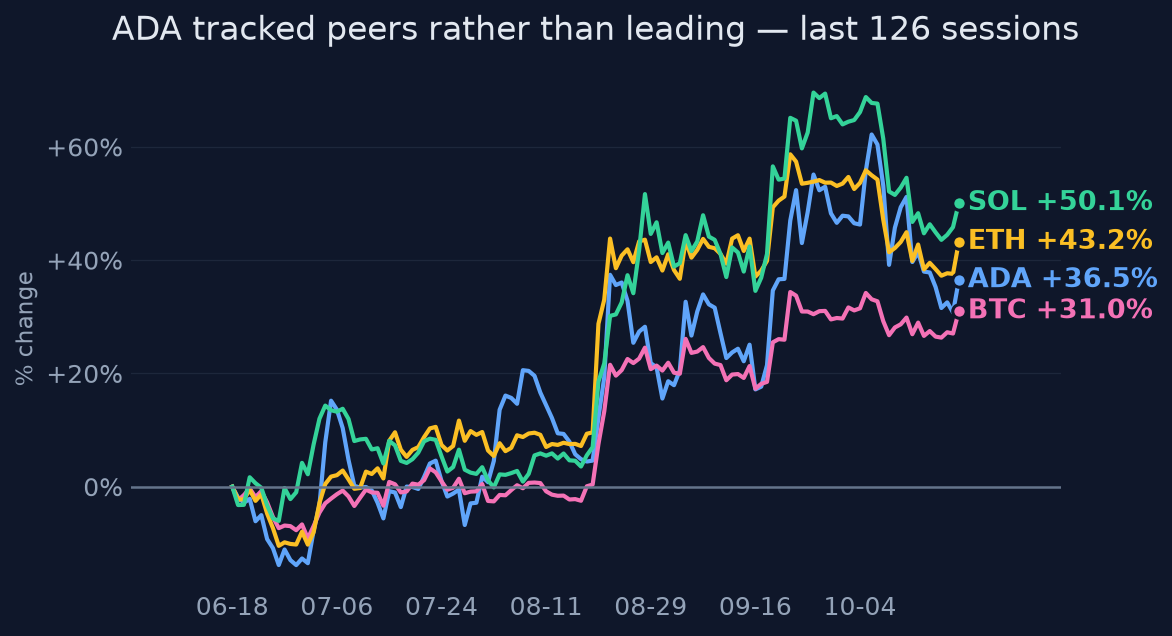
- 60d beta to BTC 1.67, correlation to ETH 0.81; +31% 3m vs ETH +30%, SOL +38% — beta, not alpha
- Relative strength vs BTC/ETH/SOL: -15% to -27% over 6m (return spread vs SOL -34.5%); -22% to -42% over 1y
- Cardano TVL $64.6M (-78% 1y, -91% from ATH); 30d fees $143.6k; 30d revenue $28.7k; mcap/TVL 132x (DefiLlama, 2026-10-21)
- '+220% fee growth' is off a ~$45k prior-month base — arithmetic, not adoption
- No burn, buyback, or fee switch; fees recycle to staking/treasury; yield funded by ~0.3% of remaining reserve per 5-day epoch (dilutive)
- Grayscale voluntarily withdrew Cardano Trust ETF S-1 via Form RW, Aug 7, 2026 (SEC EDGAR accession 0001193125-26-340377 [T1]) — no spot ADA ETF exists
- CIP-0113 live on mainnet Oct 7, 2026; Dijkstra/Leios staged rollout with possible hard fork Dec 2026-Jan 2027, higher-confidence Feb-Mar 2027 (mostly [T4] on timing; IOG blog for roadmap)
Catalysts and risks
Catalysts
- Dijkstra/Linear Leios hard fork: possible enactment Dec 5, 2026-Jan 4, 2027; higher-confidence Feb 24-Mar 26, 2027
- CAP-12 constitutional update and hard-fork governance votes (75% DRep / 60% DRep + 51% SPO thresholds)
- Musashi Dojo testnet progression (currently 'Fire' phase; ~1,000 TPS claims)
- Midnight identity product later in 2026 — watch for confirmed mainnet date and ADA value accrual
- Any renewed spot ADA ETF filing to replace the withdrawn Grayscale S-1
- Treasury withdrawal votes in Q4 2026 and whether funded spending produces measurable usage
Risks
- Hard-fork timing slippage or governance failure removes the only re-rating catalyst
- Continued relative-strength decay: ADA trades as an ETH proxy with worse returns
- Reserve-funded staking yield is dilutive; no mechanism converts usage into token value
- Treasury spending could be perceived as dilution/governance risk rather than investment
- High beta (1.67 to BTC) means a crypto downturn hits ADA disproportionately
- Key catalyst timing rests on [T4] sources; primary confirmation is thin
What to watch
- Governance vote totals for CAP-12 (75% DRep + 2/3 CC) and the Dijkstra hard fork (60% DRep + 51% SPO + 2/3 CC)
- Node 11.2/11.3 releases and Musashi testnet phase progression
- 30d fees and revenue on DefiLlama — whether the +220% growth sustains above $150k/month or mean-reverts
- TVL trend: currently $64.6M, -5.7% over 90d
- SEC EDGAR for any new Cardano ETF S-1 filings
- Net CEX inflow/outflow data for ADA (unavailable in this research — the main evidence gap)
- ADA/ETH relative strength ratio — the cleanest read on whether idiosyncratic demand is emerging
Market snapshot when the call was made 2026-10-21
Price
| Return 1w | -3.5% |
| Return 1m | -0.2% |
| Return 3m | +31.1% |
| Return 6m | -8.9% |
| Return 1y | -65.7% |
| From 52-week high | -66.6% |
| Realized vol, 20d | 75.7% |
| BTC 3m / 1y | +26.9% / -23.6% |
| ETH 3m / 1y | +29.9% / -37.1% |
| QQQ 3m / 1y | +1.7% / +18.8% |
Technicals
Verifier notes REVISE · opinion revised once
Unsupported claims
- key_evidence and answer claim relative strength vs BTC/ETH/SOL of '-16% to -35% over 6m'. The evidence's relative_strength_change_pct over 6m is -17.64% (BTC), -15.4% (ETH), -27.47% (SOL) — the worst case is -27.5%, not -35%. The -34.49% figure exists only as the 6m return *spread* vs SOL, a different metric; mixing them overstates the 6m underperformance.
Internal inconsistencies
- most_differentiated_insight attributes '75% DRep + 2/3 Constitutional Committee thresholds' to the 'Dijkstra hard-fork governance votes'. Per the evidence, 75% DRep + 2/3 CC is the threshold for the CAP-12 constitutional amendment; the Dijkstra hard fork itself requires 60% DRep + 51% SPO + 2/3 CC. The opinion's own catalysts field states the correct split ('75% DRep / 60% DRep + 51% SPO thresholds'), so the differentiated-insight claim contradicts both the evidence and the rest of the opinion.
Corrections applied
- Fix the 6m relative-strength range to '-15% to -27% over 6m' (per relative_strength_change_pct), or if the intent was the return spread, label it as spread ('-16.6% to -34.5% vs ETH/SOL') rather than relative strength.
- In most_differentiated_insight, state both thresholds correctly: 'the CAP-12 constitutional update (75% DRep + 2/3 CC) and the subsequent Dijkstra hard fork (60% DRep + 51% SPO)' — matching the catalysts field and the evidence.
Sources (16 · T1 = primary filings)
- T4https://cryptonews.net/news/altcoins/33609844/
- T4https://www.tradingview.com/news/u_today:431b9d2b4094b:0-is-cardano-complete-hoskinson-says-yes-but-there-is-o…
- T4https://cryptonews.net/news/altcoins/33623497/
- T4https://www.bitkub.com/en/blog/is-cardano-almost-complete-hoskinson-points-to-leios-OYP3QBUST74aOBdchdYDiC
- T4https://www.perplexity.ai/finance/ADAUSD
- T4https://www.iog.io/news/leios-is-coming-how-it-reaches-cardano-mainnet
- T4https://www.tokenpost.com/news/technology/34366
- T4https://en.coinotag.com/cardano-ada-etf-bid-withdrawn-by-grayscale-2-days-before-eligibility
- T1https://www.sec.gov/Archives/edgar/data/2083106/000119312526340377/ada_rw_08072026.htm
- T1https://www.sec.gov/Archives/edgar/data/2083106/000119312526340377/0001193125-26-340377-index.html
- T4https://www.thecoinrepublic.com/2026/08/10/why-did-grayscale-withdraw-its-ada-hbar-and-dot-etf-filings/
- T4https://crypto.news/grayscale-killed-three-altcoin-etfs-cardano-eligible/
- T4https://coinpaper.com/34098/grayscale-pulls-out-cardano-hedera-and-polkadot-trust-etf-filings
- T4https://finance.yahoo.com/markets/crypto/articles/breaking-grayscale-withdraws-cardano-hedera-053141740.html
- T4https://coinness.com/en/news/1165122
- T4https://cryptorank.io/news/feed/b22c9-grayscale-withdraws-cardano-polkadot-hedera-etf-filings
Want a fresh look at ADA, or another name?
Queue a new deep-research run. Published to the feed when done.
Automated research opinion, published as-is on Oct 21, 2026. Not personalised advice. Figures use end-of-day closes.