Mostly — but overdone.
Thesis
Bull case
The bull case is that the market has confused a serious but finite regulatory event with a structural earnings impairment. Core Q3 trends were resilient, Q2 ROTCE was 17%, NII momentum remained positive, credit losses were contained, and BAC continues to return substantial capital through dividends and buybacks. If adjusted EPS remains near $1.08 or better and no additional major penalty emerges, a modest rerating from about 10x earnings could produce attractive upside over 3-6 months.
Bear case
The bear case is that the AML matter is not truly one-time because BAC admitted willful violations and must fund an independent historical-transaction review, potentially creating recurring compliance costs, management distraction, and further findings. At the same time, investment-banking fees fell 11%, FICC drove a 5% trading decline, deposit costs remain vulnerable to higher-for-longer rates, and BAC has asymmetric NII downside if rates fall. At roughly 1.7x Q2 tangible book and 10x earnings, the stock is not obviously priced for a prolonged regulatory and revenue problem.
What would change our mind
- Q4 adjusted EPS falls to $1.00 or below because of recurring compliance costs, weak NII, or further fee deterioration rather than another clearly identified one-time item.
- NII on an FTE basis falls materially below Q3's $16.6 billion while deposit costs continue rising.
- Available FY2027 EPS consensus declines by more than 5% from the reported $5.11 level, though the current consensus source is lower-tier and requires confirmation.
- Regulators impose another material penalty or the independent review creates a quantified liability beyond the announced settlement.
- Net charge-offs rise materially above Q3's roughly $1.1 billion level or provisions begin accelerating.
- Management reduces buybacks or signals that compliance spending will structurally lower returns on tangible common equity.
Since publication vs SPY · closed horizons are frozen
No price data after the entry date yet.
The full research everything the view rests on
Direct answer to the question asked
Where the edge would come from
What the price assumes
At $50.85, BAC trades at roughly 10.1x forward earnings according to third-party data (StockAnalysis/Chartloom, T4) and about 1.7x its Q2 tangible book value of $29.37. That valuation appears to assume persistent regulatory and fee pressure, but not an earnings collapse — an interpretation, not a measurable fact. Because the price fell sharply while core NII and balance-sheet trends remained intact, much of the market reaction is best understood as a lower risk multiple rather than a wholesale reduction in BAC's operating earnings power.
Why the market may be wrong
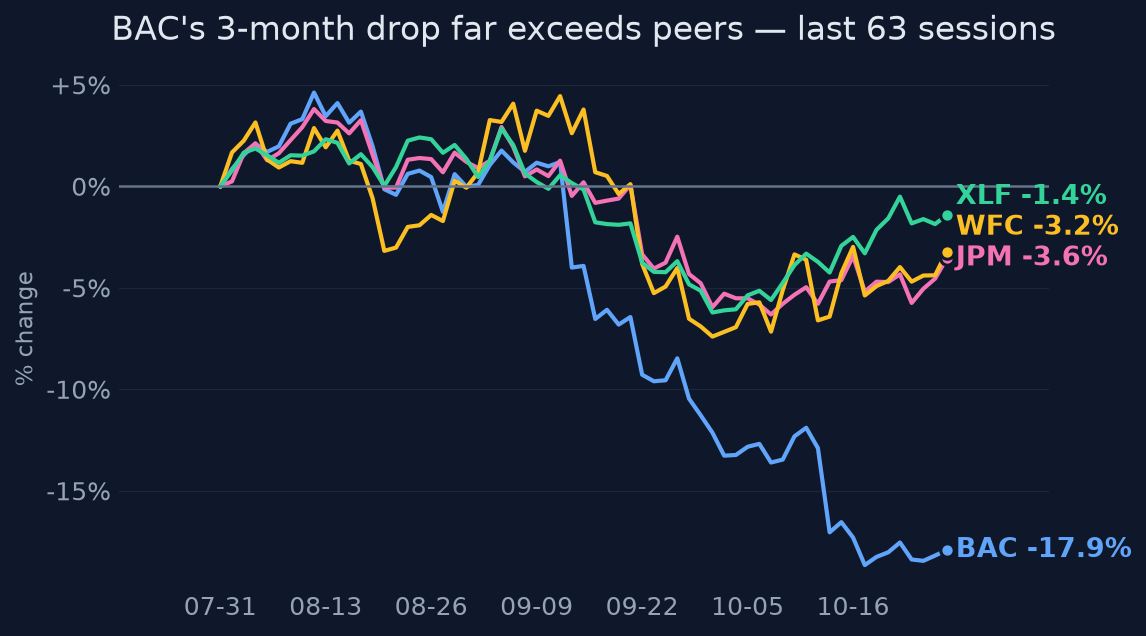
The market may be treating a finalized $1.2 billion charge and a weak fee quarter as evidence of a broader structural problem. The more complete picture from primary sources is that adjusted EPS was $1.08, NII improved 8% year over year, loans grew 7%, deposits grew 2%, and net charge-offs were roughly flat. BAC's 3-month decline of 17.6%, versus declines of 3.3% for JPM and 1.5% for XLF, also looks unusually idiosyncratic; the calculated 60-day idiosyncratic share versus SPY was 88%.
The one thing to watch
The $0.91 headline makes the quarter look broken; $1.08 adjusted EPS is the audit number, and it comes from the primary-source release, not consensus data. Since the AML charge explains approximately $0.17, the operating quarter was roughly in line with the trajectory implied by Q2's $1.21 even before debating consensus (the reported ~$1.10 expectation rests on a single weakly-sourced T4 citation). If Q4 adjusted EPS stays near or above $1.08 and estimates do not materially fall, this was regulatory multiple compression rather than earnings deterioration.
Key evidence (12)
- FACT: BAC closed at $50.85 on October 29, 2026, down 7.5% over one month, 17.6% over three months, and 21.5% below its 52-week high. [Market data, 2026-10-29]
- FACT: Over three months, JPM fell 3.3%, WFC fell 2.1%, and XLF fell 1.5%, making BAC's 17.6% decline predominantly stock-specific rather than sector-wide. [Quant analysis, 2026-10-29]
- FACT: Q3 2026 GAAP EPS was $0.91; adjusted EPS was $1.08 after a roughly $1.2 billion non-deductible regulatory settlement charge that reduced EPS by about $0.17. [T1 BAC Q3 release, 2026-10-14]
- FACT: Q3 NII rose 8% year over year to $16.4 billion, or $16.6 billion FTE; loans rose 7% to $1.25 trillion and deposits rose 2% to $2.04 trillion. [T1 BAC Q3 release, 2026-10-14]
- FACT: Q3 credit provisions were $1.0 billion and net charge-offs were about $1.1 billion, roughly flat year over year. [T1 BAC Q3 materials, 2026-10-14]
- FACT: FinCEN announced a $1.2 billion AML penalty on October 13, 2026, alongside coordinated OCC and OFAC actions; BAC admitted willful Bank Secrecy Act violations, and an independent historical-transaction review remains required. [T1 FinCEN/Treasury and T2 Reuters, 2026-10-13/14]
- FACT: Q2 2026 EPS was $1.21, ROTCE was 17.0%, tangible book value per share was $29.37, and management expected full-year NII growth toward the upper end of its 6%-8% range. [T1 SEC exhibit, July 2026]
- FACT: BAC raised its quarterly dividend 14% to $0.32 and repurchased $13.2 billion of stock in the first half of 2026 under a $40 billion authorization. [T1 company materials, 2026]
- FACT: The Fed raised rates by 25 basis points in September to 3.75%-4.00% and held on October 28; BAC's Q2 sensitivity disclosure estimated that a parallel 100-basis-point decline would reduce next-12-month NII by $2.2 billion, versus only a $1.0 billion benefit from a 100-basis-point increase. [T2 Reuters and T1 BAC/SEC materials, 2026]
- WEAKLY SOURCED: The reported Q3 consensus of ~$1.10 EPS (implying a ~$0.02 adjusted miss) rests on a single T4 MarketBeat citation; the primary-source pull explicitly found no consensus figures. The 'miss' framing should be treated as approximate, not established.
- ASSUMPTION/WEAKLY SOURCED: Available third-party consensus showed approximately $4.39 of FY2026 EPS and $5.11 of FY2027 EPS, but the bundle lacks a reliable revision history; this should not be treated as T1 evidence. [T4 StockAnalysis, October 2026]
- ASSUMPTION: The $1.2 billion penalty will remain non-recurring and remediation costs will be manageable. The penalty itself is final, but future remediation expense and findings from the mandated lookback are not yet quantified.
Catalysts and risks
Catalysts
- Q4 2026 earnings and management's first full update on FY2027 NII, expenses, credit, and capital returns.
- Disclosure of the cost and scope of the independent AML transaction review.
- Any additional FinCEN, OCC, OFAC, or related enforcement developments.
- Evidence that investment-banking and FICC revenues are stabilizing after Q3 weakness.
- Changes in the Fed path, long-term Treasury yields, deposit pricing, and BAC's updated rate sensitivity.
- Share-repurchase pace under the remaining $40 billion authorization.
Risks
- The AML lookback identifies additional violations or materially increases remediation and compliance spending.
- The Q3 fee weakness persists, particularly in investment banking and FICC.
- Deposit repricing offsets asset-yield benefits and slows NII momentum.
- Falling rates trigger the disclosed asymmetric NII downside, while elevated long yields pressure securities values.
- Consumer or commercial credit losses rise above the current contained level.
- The current valuation is not distressed enough to absorb both a regulatory overhang and weaker capital-markets revenue.
- The bearish technical trend and weak relative performance could continue even without another fundamental disappointment.
What to watch
- First, adjusted EPS: Q3's clean number was $1.08 after excluding the approximately $0.17 settlement impact — judge Q4 against that primary-source figure, not against an unverified consensus.
- FTE NII relative to Q3's $16.6 billion and management's updated FY2027 NII commentary.
- Compliance and remediation expense separate from the finalized $1.2 billion charge.
- Deposit balances, deposit pricing, and any change in BAC's asymmetric rate sensitivity.
- Investment-banking fees after Q3's 11% decline and FICC revenue after the 5% trading decline.
- Net charge-offs and reserve releases relative to Q3's roughly $1.1 billion and $94 million, respectively.
- Buyback execution and management's willingness to lean into the lower share price.
Market snapshot when the call was made 2026-10-28
Price
| Return 1w | +0.1% |
| Return 1m | -7.5% |
| Return 3m | -17.6% |
| Return 6m | -3.3% |
| Return 1y | -2.5% |
| From 52-week high | -21.5% |
| Realized vol, 20d | 21.1% |
| SPY 3m / 1y | +4.1% / +12.7% |
| QQQ 3m / 1y | +6.2% / +15.5% |
Technicals
BAC technicals as of 2026-10-28: last close $50.85; 20d SMA 52.27 (bearish); 50d SMA 56.91; 12d EMA 51.41; 26d EMA 53.20; RSI 14 31.2 (balanced); 20d vol 20.5%; volume x0.6 vs 20d avg
Verifier notes REVISE · opinion revised once
Weakly sourced
- The '$1.10 consensus / two-cent miss' claim — central to the direct_answer and most_differentiated_insight ('the operating miss was only $0.02 versus the reported $1.10 consensus') — rests solely on a single [T4] MarketBeat citation. The primary-source earnings pull explicitly states consensus figures were not available, and the bundle itself labels the MarketBeat data 'weakly sourced.' The opinion presents the $1.10 expectation as established fact while flagging the same-tier FY consensus data as untrustworthy, an inconsistent standard for its headline number.
- '10.1x forward earnings according to third-party data' is acceptable, but the related claim in market_expectation that the valuation 'appears to assume persistent regulatory and fee pressure' is interpretive; not a violation, but the opinion appropriately hedges it — no fix needed beyond noting the forward P/E itself is T4-sourced (StockAnalysis/Chartloom), which the opinion does acknowledge.
Internal inconsistencies
- None material: view LEAN_BULLISH with conviction 5.5 sits inside the 5-6 band; direct_answer ('Mostly — but overdone') aligns with a lean-bullish 'overdone selloff' thesis; bull/bear cases are consistent with key evidence; invalidation_conditions are falsifiable.
Corrections applied
- Qualify the $1.10 consensus figure wherever used (answer, most_differentiated_insight): e.g., 'versus a reported ~$1.10 expectation from a single third-party source (MarketBeat), which the evidence bundle flags as weakly sourced — so the characterization of a two-cent operating miss should be treated as approximate.' Alternatively, restate the 'one number to check' purely on T1 data: adjusted EPS of $1.08 ex the ~$0.17 settlement impact, without anchoring to the unverified consensus.
Sources (39 · T1 = primary filings)
- T1https://investor.bankofamerica.com/regulatory-and-other-filings/select-sec-filings/content/0000070858-26-00048…
- T1https://investor.bankofamerica.com/?hl=en-US
- T1https://investor.bankofamerica.com/regulatory-and-other-filings/select-sec-filings/content/0000070858-26-00048…
- T2https://www.reuters.com/business/finance/bank-america-profit-hurt-by-12-billion-fine-over-anti-money-launderin…
- T1https://investor.bankofamerica.com/regulatory-and-other-filings/select-sec-filings/content/0000070858-26-00048…
- T4https://newsroom.bankofamerica.com/content/newsroom/press-releases/2026/10/bank-of-america-reports-third-quart…
- T3https://www.cnbc.com/2026/10/14/bank-of-america-bac-q3-2026-earnings.html
- T1https://investor.bankofamerica.com/events-and-presentations/events/detail/20261014-q3-2026-bank-of-america-ear…
- T3https://www.cnbc.com/2026/10/18/stock-market-today-live-updates.html
- T4https://riabiz.com/a/2026/10/20/bank-of-america-analyst-double-slams-ameriprise-not-least-because-ria-structur…
- T4https://www.marketbeat.com/ratings/by-issuer/bank-of-america-stock-recommendations/
- T4https://finance.yahoo.com/markets/stocks/articles/bank-america-bac-stock-sees-111757553.html
- T4https://247wallst.com/investing/2026/10/23/bank-of-america-fell-harder-than-wells-fargo-does-that-make-it-the-…
- T4https://www.marketbeat.com/instant-alerts/analyst-bank-of-america-nyse-bac-price-target-cut-to-5600-by-analyst…
- T4https://www.benzinga.com/analyst-stock-ratings/downgrades/26/10/62568665/nvr-faces-double-squeeze-as-homebuyer…
- T4https://www.perplexity.ai/finance/BAC?comparing=BAC,JPM,C,BMO,HSBC,WFC
- T4https://newsroom.bankofamerica.com/content/newsroom/press-releases/2026/07/bank-of-america-reports-second-quar…
- T1https://www.sec.gov/Archives/edgar/data/70858/000007085826000353/bac06302026ex992.htm
- T1https://investor.bankofamerica.com/regulatory-and-other-filings/select-sec-filings/content/0000070858-26-00035…
- T4https://stockanalysis.com/stocks/bac/transcripts/649666-q2-2026/
- T4https://newsroom.bankofamerica.com/content/newsroom/press-releases/2026/10/bank-of-america-declares-fourth-qua…
- T1https://www.sec.gov/Archives/edgar/data/70858/000007085826000364/exhibit991.htm
- T1https://investor.bankofamerica.com/regulatory-and-other-filings/select-sec-filings/content/0000070858-26-00036…
- T4https://stockanalysis.com/stocks/bac/transcripts/
- T2https://www.reuters.com/business/fed-highlights-economic-strength-muddies-outlook-treasuries-2026-10-29/
- T3https://www.cnbc.com/2026/10/28/us-treasurys-bonds-yields-federal-reserve.html
- T2https://www.reuters.com/markets/us/us-bonds-fall-lifting-yields-2nd-day-oil-weighs-30-year-auction-looms-2026-…
- T2https://www.reuters.com/business/finance/us-10-year-treasury-yield-levels-not-unprecedented-bny-ceo-says-2026-…
- T3https://www.cnbc.com/2026/10/28/fed-interest-rate-decision-october-2026.html
- T2https://www.reuters.com/business/lower-us-treasury-yield-view-persists-despite-biggest-quarterly-surge-since-1…
- T4https://www.fidelity.com/news/article/us-markets/202610191117RTRSNEWSCOMBINED_L6N4650Z6_1
- T1https://home.treasury.gov/resource-center/data-chart-center/interest-rates/TextView?type=daily_treasury_yield_…
- T2http://rmb.reuters.com/rmd/rss/item/tag:reuters.com,2026:newsml_KBN3VU1EW?channel=FES376
- T2https://www.reuters.com/legal/legalindustry/bofa-fined-12-billion-by-us-government-failing-police-suspicious-a…
- T3https://www.cnbc.com/2026/10/13/bank-of-america-treasury-money-laundering.html
- T4https://www.kxan.com/business/press-releases/newmediawire/9202b17e/kaplan-fox-encourages-investors-of-bank-of-…
- T4https://www.bankingdive.com/news/bofa-fined-1-21-billion-over-aml-bsa-occ-treasury/832915/
- T1https://home.treasury.gov/news/press-releases/sb0657/
- T1https://www.fincen.gov/news/news-releases/fincen-assesses-12-billion-penalty-against-bank-america
Earlier and later calls on BAC
- Oct 13, 2026Low bar — except NII guidance.Lean bullish
Want a fresh look at BAC, or another name?
Queue a new deep-research run. Published to the feed when done.
Automated research opinion, published as-is on Oct 29, 2026. Not personalised advice. Figures use end-of-day closes.