No edge — estimates still falling.
Thesis
Bull case
At ~15x forward earnings (5-year low) with a 4.6% yield covered by earnings, the market is paying nothing for a recovery. NA volumes are sequentially improving, international is growing (global beverage volume +3%), Elliott's SKU rationalization and the newly flagged cost cuts could fund the pricing investment and set up margin recovery in 2027, and the Rockstar-impaired 2025 base makes core growth optics look better than reported. If FY27 estimates hold near $8.9 and the multiple merely re-rates to 17x, the stock is ~$150 — matching the Street target — while the dividend pays you ~4.6% to wait.
Bear case
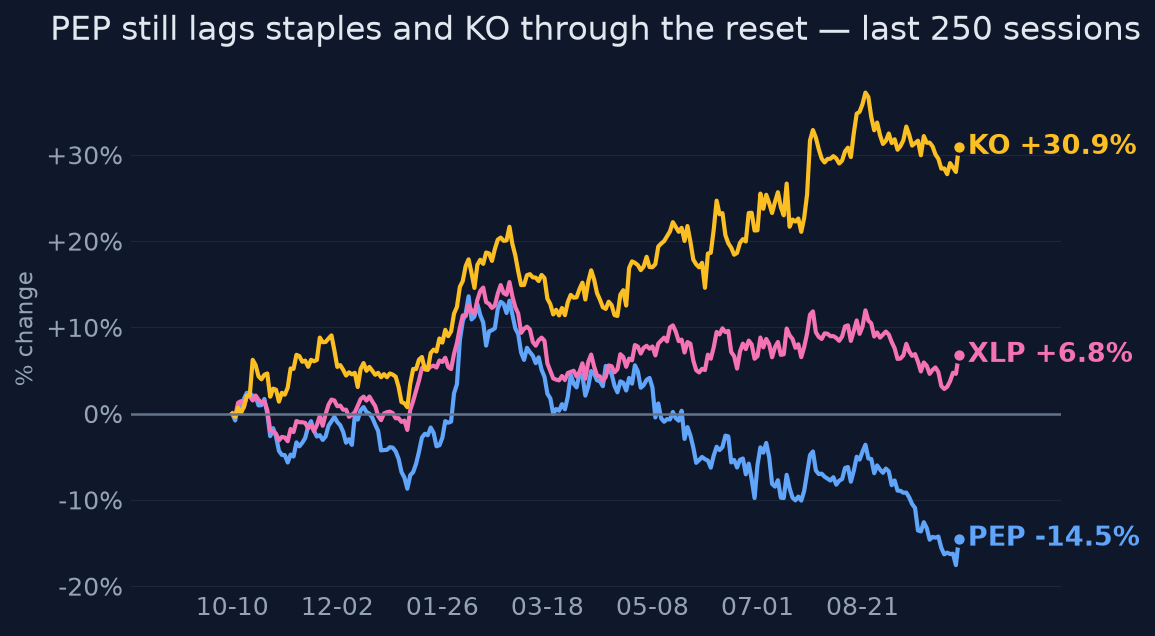
This is a value trap in a structural demand shift. GLP-1 household penetration more than doubled in 16 months and directly attacks Frito-Lay's core mix; management's own 2027 pricing reset admits affordability is a lasting problem, not a blip. Consensus EPS sits above the guidance ceiling, Q3's beat was manufactured by tariff refunds while FLNA margin collapsed 280bps, and the next data point (Feb 2027) is more likely to bring a 2027 framework reset than relief. FCF payout near 87% leaves no room for a dividend-growth offset if margins keep sliding. The KO comparison (+4% NA volume, +31% stock) proves this is PEP-specific execution and mix, not a defensive-rotation entry.
What would change our mind
- If the next two earnings prints show FLNA core operating margin stabilizing or improving ex-one-offs while NA beverage volumes turn positive, the structural-deterioration leg of the bear case fails and the value case activates
- If FY27 consensus EPS holds at ~$8.9 through the February guidance while the stock stays below ~$130, that is genuine multiple compression and a buyable dislocation, not deterioration
- If announced cost cuts are quantified at a level that funds pricing investment with net EPS accretion, the negative-revision thesis is invalidated
- Conversely, a dividend coverage breach (FCF payout >100%) or a 2027 guide below ~$8.20 would invalidate the 'cushioned downside' assumption and make this LEAN_BEARISH
Since publication vs SPY · closed horizons are frozen
The full research everything the view rests on
Direct answer to the question asked
Where the edge would come from
What the price assumes
At $128.34 / ~15.3x the guidance midpoint, the market prices PEP as a no-growth staple propped up by its dividend. However, sell-side consensus has not fully internalized the guidance cut: FY26 consensus $8.55 exceeds the $8.42 guidance ceiling, and the average analyst target of ~$148.64 implies ~16% upside that depends on a recovery management itself pushed out. The 'Hold' consensus with targets well above spot signals analysts expect stabilization rather than further cuts — an assumption the Q3 evidence contradicts.
Why the market may be wrong
Both directions are arguable. Bears may be wrong because the stock already trades at its lowest forward multiple in ~5 years with a 4.6% yield, Elliott is enforcing portfolio simplification (~20% US SKU cut), and NA volume trends are sequentially improving (food flat vs negative, beverages -2% vs -4% in Q2). Bulls (and the $148 target) may be wrong because: (1) consensus EPS is above the guidance ceiling, so revisions have further to fall; (2) the Q3 beat leaned on a 4pp tariff-refund tailwind that won't repeat; (3) the 2027 pricing reset guarantees margin pressure persists for at least 12+ months; and (4) GLP-1 adoption more than doubled in 16 months and directly targets PEP's salty-snack mix.
The one thing to watch
The variable to watch is not organic revenue (which is fine at +3.1%) but Frito-Lay North America core operating margin: management's decision to hold 2027 pricing below 2025 levels converts what looks like cyclical volume weakness into a deliberate, multi-year margin reset — and the Q3 'beat' (4pp of core operating profit from tariff refunds while FLNA margin fell 280bps) shows reported EPS is now being smoothed by one-offs, meaning the quality of future beats matters more than their existence.
Key evidence (10)
- Q3 2026 (Oct 8, 2026): net revenue +5.6%, organic +3.1%, core cc EPS +1.5%; FY26 organic revenue guidance narrowed to ~3% and core EPS guidance cut to +2.5–3.5% (~$8.34–8.42) from prior +4–6% core cc [T1 prepared remarks/8-K; T2 Reuters]
- Q3 core operating profit included a 4-percentage-point favorable impact from tariff refunds while overall core operating margin fell 35bps [T1 Q3 release]
- Frito-Lay NA core operating margin fell 280bps in Q3 (affordability price investments, higher A&M, lapping asset-sale gain); PBNA margin -15bps [T1 prepared remarks]
- NA food volumes flat and NA beverage volumes -2% y/y in Q3 (vs -4% in Q2); prices cut up to 15% on Lay's/Doritos in 2026; 2027 pricing guided below 2025 levels [T2 Reuters; T1]
- FY26 EPS consensus ~$8.55 vs guidance ceiling $8.42; FY27 consensus $8.91–8.96 already drifting down over 3 months [T4 estimate aggregators — weakly sourced, flagged]
- GLP-1 adoption reached 21% of US households in May 2026 vs 9% in Jan 2025, with users cutting salty snacks and sweets [T2 Reuters citing PwC/Numerator]
- PEP -8.8% 1y vs XLP +6.7% and KO +31.4%; 60d correlation to XLP 0.83; max drawdown 27%; forward P/E ~15x, lowest in ~5 years [quant analysis; T4]
- FY2025 reported EPS fell to $6.00 from $6.95 mainly on Rockstar brand impairment — not core erosion [T1 Q4-25 release]
- Dividend $5.92/yr (~4.6% yield); payout ~75% of earnings, ~87% of FCF; net debt ~$40B / ~2.3x EBITDA [T4 dividend analyses — moderately sourced]
- Elliott built ~$4B (~2%) stake in 2025; Dec 2025 agreement drove ~20% US SKU reduction and further cost cuts are flagged [T2/T4]
Catalysts and risks
Catalysts
- Q4/FY26 report and 2027 guidance, Feb 1, 2027 — the decisive event; a 2027 core EPS framework materially below the ~$8.9 consensus would force another leg of estimate cuts
- Announcement of the additional cost-cut program management flagged for 'coming months' — size and EPS funding mechanics matter
- Elliott-related strategic moves (further portfolio divestitures, PBNA restructuring)
- Analyst estimate revisions over the next 1-2 months as consensus converges toward/below $8.42
- GLP-1 adoption data updates and any SNAP policy changes affecting snack demand
- KO and MDLZ quarterly prints as read-throughs on whether NA weakness is PEP-specific
Risks
- FY27 consensus (~$8.9) proves too high given the pricing reset, triggering another de-rating leg in February
- GLP-1-driven volume decay accelerates rather than stabilizes; no stabilization rate is observable yet
- Cost cuts fail to offset pricing investment, pushing margin recovery beyond 2027
- FCF payout (~87%) limits buyback/dividend flexibility if earnings disappoint
- Tariff-refund tailwind annualizes, making 2027 comps optically worse
- Estimate/consensus data in the bundle is T4-sourced; the $8.55 consensus figure may itself be stale, weakening the revision-gap argument
What to watch
- Frito-Lay NA core operating margin ex-one-offs each quarter — the single most informative line item
- Consensus FY26/FY27 EPS revisions between now and Feb 1, 2027 (does $8.55 converge to $8.38 or below?)
- NA beverage volume trajectory (-4% Q2 → -2% Q3 → ? Q4)
- Size/structure of the flagged additional cost cuts and whether they fund pricing investment
- GLP-1 household adoption updates (PwC/Numerator) for evidence of a plateau
- Whether the stock continues trading as an XLP proxy (corr 0.83) or decouples on idiosyncratic news
Market snapshot when the call was made 2026-10-08
Price
| Return 1w | +2.2% |
| Return 1m | -6.1% |
| Return 3m | -6.6% |
| Return 6m | -18.5% |
| Return 1y | -8.8% |
| From 52-week high | -24.7% |
| Realized vol, 20d | 20.7% |
| SPY 3m / 1y | +2.5% / +15.7% |
| QQQ 3m / 1y | +3.0% / +23.7% |
Technicals
PEP technicals as of 2026-10-08: last close $128.34; 20d SMA 129.62 (bearish); 50d SMA 135.80; 12d EMA 127.59; 26d EMA 130.71; RSI 14 45.6 (balanced); 20d vol 20.7%; volume x2.3 vs 20d avg
Next earnings: 2027-02-01 AMC
Sources (34 · T1 = primary filings)
- T2https://www.reuters.com/business/retail-consumer/pepsico-cuts-annual-core-profit-forecast-higher-costs-hurt-ma…
- T1https://investor.pepsico.com/docs/pepsico-5v9wci20/media/Files/investors/q3-2026-prepared-management-remarks.p…
- T3https://www.cnbc.com/2026/10/08/pepsico-pep-q3-2026-earnings.html
- T4https://investors.pepsico.com/docs/pepsico-5v9wci20/media/Files/investors/q3-2026-earnings-release.pdf
- T4https://finance.yahoo.com/markets/stocks/articles/pepsico-eyes-cost-cuts-north-150000826.html
- T4https://www.tradingkey.com/news/transcripts/262206977-tradingkey
- T4https://www.mitrade.com/insights/news/live-news/article-8-2149628-20261009
- T4https://www.benzinga.com/news/26/10/62244871/pepsico-q3-2026-earnings-call-complete-transcript
- T2https://www.reuters.com/business/finance/pepsicos-turnaround-stutters-americans-rethink-snacking-2026-07-14/
- T4https://www.ssga.com/se/en_gb/institutional/etfs/state-street-consumer-staples-select-sector-spdr-etf-xlp
- T4https://brandequity.economictimes.indiatimes.com/amp/news/business-of-brands/pepsicos-turnaround-stutters-as-a…
- T4https://www.tradingpedia.com/2026/07/14/pepsico-faces-weak-snack-demand-as-consumer-habits-shift/
- T4https://finance.yahoo.com/quote/XLP/
- T4https://marketxls.com/etfs/xlp/holdings
- T4https://www.schwab.wallst.com/Prospect/Research/etfs/portfolio.asp?symbol=xlp
- T4https://journalrecord.com/2026/10/07/pepsico-growth-challenges-glp-1-drug-impact-north-america/
- T4https://investors.pepsico.com/docs/pepsico-5v9wci20/media/Files/investors/q4-2025-earnings-release.pdf
- T4https://www.techtimes.com/articles/328651/20261006/pepsico-q3-report-thursday-two-downgrades-signal-frito-lay-…
- T4https://www.panabee.com/news/pepsico-dividend-analysis-q2-2026
- T4https://pepsico.gcs-web.com/static-files/80ec0ab1-7705-45ed-952a-5b603e17a61f
- T4https://www.panabee.com/testNewsArticle/news/pepsico-dividend-analysis-q1-2026
- T4https://www.panabee.com/news/pepsico-dividend-analysis-q1-2026
- T4https://247wallst.com/investing/2026/10/08/three-soda-giants-pay-dividends-one-has-a-much-stronger-income-stor…
- T4https://stockanalysis.com/stocks/pep/statistics/
- T1https://www.sec.gov/Archives/edgar/data/77476/000007747626000050/q320268-kxexhibit991.htm
- T4https://finance.yahoo.com/markets/stocks/articles/pepsico-cut-costs-lowering-earnings-132355349.html
- T4https://www.stocktitan.net/sec-filings/PEP/8-k-pepsico-inc-reports-material-event-d3b6726b95a4.html
- T4https://www.stocktitan.net/articles/pepsico-q3-2026-earnings-tariff-refunds-snack-margin
- T4https://www.ad-hoc-news.de/boerse/news/corporate-news/pepsico-cuts-profit-outlook-as-pepsico-stock-gains-1-87-…
- T4https://sg.finance.yahoo.com/news/pepsico-shares-climb-q3-beat-104111993.html
- T1https://investor.pepsico.com/docs/pepsico-5v9wci20/media/Files/investors/q3-2026-earnings-release.pdf
- T4https://quartr.com/events/pepsico-inc-pep-q3-2026_3es6rx4W
- T4https://ca.investing.com/news/earnings/pepsico-shares-climb-after-q3-beat-though-company-trims-profit-forecast…
- T4https://www.investing.com/equities/pepsico-earnings
Want a fresh look at PEP, or another name?
Queue a new deep-research run. Published to the feed when done.
Automated research opinion, published as-is on Oct 9, 2026. Not personalised advice. Figures use end-of-day closes.