Liquid, yes — but not activity-backed.
Thesis
Bull case
The activity collapse is a feature, not a bug: Helicon deliberately purged bot/spam volume (gas use -66%, bot tx -50%+), so the chain now shows its real user base while earning 3.6x more revenue per unit of activity — a cleaner, higher-quality chain. Spot ETFs (with Bitwise reportedly staking ~70% of holdings) create a structural, float-reducing bid that is early (combined ~1.2% of supply) with room to scale, and the RWA franchise (~$1.7B tokenized assets, Goldman fund access via Lynq) is the one L1 narrative with genuine institutional pull. AVAX is still -93% from ATH with mcap/FDV at 0.94 and ~40% of supply staked, so if crypto beta stays constructive (BTC +29% 3m) and ETF flows inflect, a re-rating toward prior-cycle multiples has large headroom from $10.49.
Bear case
A $4.9B FDV chain generating ~$433K/month of revenue (935x FDV/revenue) just rallied 56% in three months on ETF optics and an RWA story while its measured usage fell 50-93% depending on the window — and the pre-purge baseline itself was heavily synthetic (one contract's wallets = 95% of Q2 active addresses; two bot clusters = 65% of recent DEX volume). The ETF 'bid' is rounding error (~$21M AUM for the largest fund) against $241M daily volume, ~0.7% of supply unlocks in the next two weeks with recurring events through year-end, and staking emissions continue against trivial fee burn, so the token remains net inflationary with no protocol fee switch. Price is already below its 20d SMA with momentum fading (7d -2.8%) — classic late-stage narrative exhaustion into supply.
What would change our mind
- Post-Helicon daily transactions and active addresses (excluding identified bot clusters) recover to or above pre-upgrade levels within 60 days while fees hold the new floor — that would show real demand at higher prices and invalidate the 'administered revenue' thesis
- Combined spot ETF AUM scales to >$250M with sustained weekly net inflows, making the institutional bid mechanically relevant versus daily volume
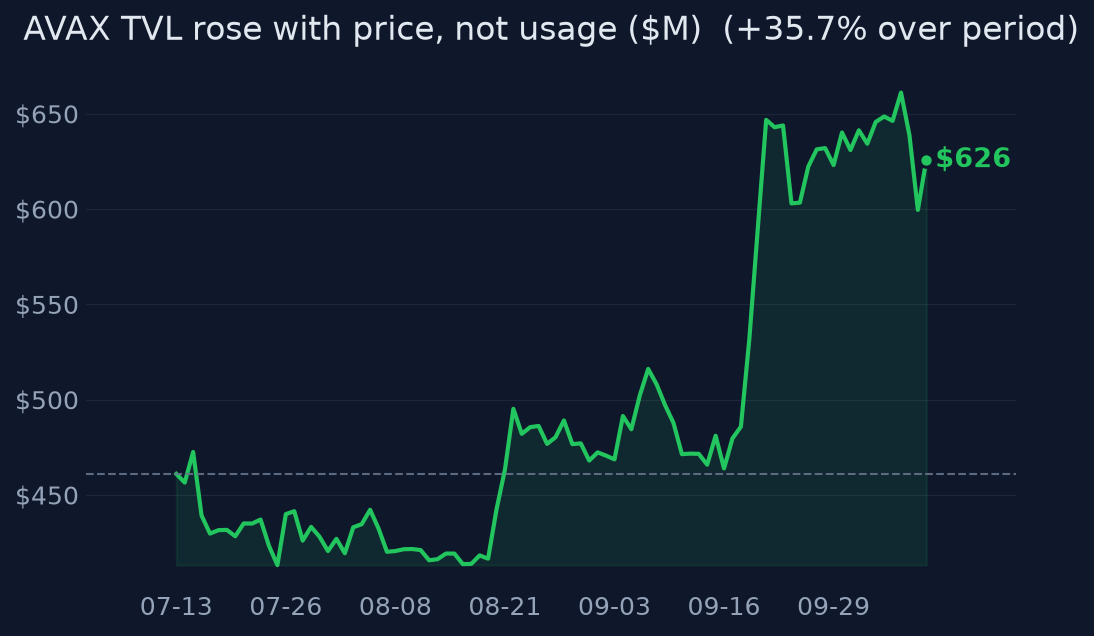
- Token-denominated TVL (not USD) rises for two consecutive months, proving capital inflow independent of price
- A confirmed, dated institutional deployment (tokenized-stock trading, government tokenization) goes into production on Avalanche
- Price breaks below the 50d SMA (~$8.9) on rising volume with ETF outflows — that would confirm the bear case faster than fundamentals and argue against averaging down
Since publication vs BTC · closed horizons are frozen
The full research everything the view rests on
Direct answer to the question asked
Where the edge would come from
What the price assumes
At ~7.4x mcap/TVL and ~935x FDV/annualized revenue after a +56% 3-month run, the price appears to assume that ETF flows scale meaningfully from a tiny base (VanEck ~$20.6M AUM), that RWA tokenization on Avalanche (reported ~$1.7B) converts into durable fee-generating activity, and that the post-Helicon activity collapse is purely bot-purge with organic users intact. In effect, the market is paying 2021-narrative multiples on 2026 revenue.
Why the market may be wrong
The 'rising activity' evidence is circular or administered: USD TVL mechanically tracks the AVAX price, and the +260% fee jump coincides with a deliberate gas-floor increase while transactions fell 54-74% and October's first week showed a ~93% drop. If post-purge organic usage is as thin as the address-quality data suggests (95% of Q2 active addresses tied to one contract's wallets; two bot clusters = 65% of recent DEX volume), then the fundamental leg of the rally doesn't exist and the ETF bid (~5M AVAX implied holdings, sporadic sub-$3M daily flows) is too small to defend a $4.65B cap against unlock supply and momentum exhaustion. Conversely, the market could be wrong the other way if the bot-purge interpretation is correct and retained users plus ETF staking flows tighten float more than the raw transaction counts imply — but that requires data we don't yet have.
The one thing to watch
The single most misread number in this rally is the +260% fee growth: it is a price change, not a quantity change — Avalanche raised its gas floor (ACP-283/Helicon) while transaction volume collapsed ~74%, so 'revenue growth' here is administered, and the variable to watch is post-Helicon organic transaction retention, not the fee line. If fees hold while transactions stay down, revenue is a tax on a shrinking base; if transactions recover at the new floor, the bull case gets its first real leg.
Key evidence (10)
- Price $10.49, +34.6% 1m / +55.7% 3m / -63.1% 1y; 60d beta to BTC 1.04 with correlation only 0.5 → ~75% idiosyncratic move (CoinGecko, computed daily history, as of 2026-10-10)
- 24h volume $241M on $4.65B mcap (5.2%) — adequate liquidity, not a thin book (CoinGecko, 2026-10-10)
- TVL $626M: +28% 30d / +36% 90d but -71% 1y and -94.6% below ATH; mcap/TVL 7.4x (DefiLlama, 2026-10-10) [T3]
- Fees/revenue ~$433K over 30d (~$7K/day), +260% vs prior 30d; FDV/annualized revenue ~935x (DefiLlama, 2026-10-10) [T3]
- Helicon upgrade activated Sep 22, 2026 (AvalancheGo v1.15.0); ACP-283 gas-floor change followed by gas usage down >2/3 and bot transactions down >50% (Bitquery investigations) [T4 — not independently verified at T1/T2]
- Usage contraction: September transactions -54.3%, 30d transactions -74%, daily active addresses -48.5%, first 8 days of October -93% (soci4l/Bitquery) [T4 — key bearish claim rests on lower-tier sources]
- Activity-quality flags: 95% of Q2 active addresses tied to one contract's wallets; two bot-funded clusters generated 65% of DEX volume Sep 27-Oct 4 (Bitquery) [T4]
- Spot AVAX ETFs exist (VanEck VAVX, Bitwise BAVA, Grayscale GAVA) but tiny: VanEck ~$20.6M AUM (Sep 28), combined ~1.22% of supply implied (~5.1M AVAX), sporadic daily flows ($268K Oct 1; reported $2.5M Oct 8) — all secondary-sourced [T4]; Glassnode table internally inconsistent [T3]
- RWA narrative: reported ~$1.7B tokenized RWA on Avalanche, +$266M/30d, Lynq/Goldman FS Treasury access — provisional, single-sourced [T4]
- Unlocks imminent but calendars disagree: Oct 21 (3.58M AVAX, ~0.7% mcap), Oct 24 (1.67M), Nov 8 (1.67M Foundation), recurring Nov/Dec events [T4 trackers, unverified against vesting contracts]
Catalysts and risks
Catalysts
- Oct 21 and Oct 24, 2026 token unlocks (~5.25M AVAX combined, per disagreeing trackers) — first supply test of the rally
- Nov 8, 2026 Foundation unlock (~1.67M AVAX) and recurring Nov/Dec releases
- Monthly ETF flow/AUM data for VAVX/BAVA/GAVA — a sustained >$10M/week inflow trend would upgrade the mechanical-bid thesis
- Post-Helicon (post-Sep 22) organic transaction and active-address stabilization data over the next 30-60 days
- Any confirmed production launch of the tokenized-stock trading or Korea tokenization pilots currently circulating as unconfirmed speculation
- Further Avalanche mainnet upgrades or governance proposals (none dated in next 90 days as of research) within the horizon
Risks
- The bearish usage data rests on T4 sources (Bitquery, soci4l) — if their methodology overstates the decline, the core bear leg weakens
- USD-denominated TVL and fee metrics are price-correlated; a flat AVAX price makes 'fundamental growth' vanish mechanically
- ETF flow data is unreliable at present (internally inconsistent Glassnode table); the true institutional bid could be larger or smaller than reported
- Crypto beta dominates tails: a BTC drawdown would hit AVAX at ~1.0 beta with 90th-percentile vol; a BTC melt-up could carry the narrative regardless of fundamentals
- Staking emissions continue with negligible fee burn — persistent structural dilution against the 720M cap
- Unlock calendar uncertainty: trackers disagree on dates/amounts, so supply events may land at unexpected times
What to watch
- Post-Helicon organic transaction count and active addresses at the new gas floor — the single decisive variable
- Daily/weekly flows into VAVX, BAVA, GAVA from a primary source (Farside or issuer disclosures), not secondary reports
- Whether the Oct 21/24 and Nov 8 unlocks are absorbed (price holds ~$9-10) or mark local tops
- Pharaoh/non-bot share of DEX volume — whether the two bot clusters' 65% share declines without total volume collapsing
- Token-denominated TVL trend to strip out price effects
- RSI and 20d SMA behavior: price currently 3.8% below the 20d with RSI 53 — a failure to reclaim the 20d within 2 weeks signals momentum rollover
- Verification of the ~39.7% staking ratio and any change in Bitwise's reported ~70% staking of ETF holdings
Market snapshot when the call was made 2026-10-10
Price
| Return 1w | -2.8% |
| Return 1m | +34.6% |
| Return 3m | +55.7% |
| Return 6m | +11.7% |
| Return 1y | -63.0% |
| From 52-week high | -63.0% |
| Realized vol, 20d | 97.7% |
| BTC 3m / 1y | +29.4% / -31.8% |
| ETH 3m / 1y | +39.7% / -42.6% |
| QQQ 3m / 1y | +5.5% / +22.9% |
Technicals
Verifier notes PASS
Weakly sourced
- The core bearish usage-collapse data (transactions -74% 30d, September -54.3%, October first week -93%, 95%-of-Q2-addresses single-contract flag, bot clusters = 65% of DEX volume) rests entirely on [T4] sources (Bitquery, soci4l). However, the opinion explicitly tags these [T4] in key_evidence, flags it in risks, and sets evidence_quality to 6 — the weakness is disclosed, not hidden, so this does not rise to a finding.
Internal inconsistencies
- key_evidence bullet 4 states 'Fees/revenue ~$433K over 30d (~$7K/day)' — $433K/30 days implies ~$14.5K/day; the ~$7K figure is the latest single-day reading ($7,260 total24h), not the 30d daily rate, so the two numbers in the same bullet do not reconcile. Immaterial to the thesis (either figure is trivial vs $4.9B FDV).
- The last invalidation_condition ('Price breaks below the 50d SMA (~$8.9)...') explicitly says it 'would confirm the bear case' — a confirmation trigger listed under invalidation conditions. It is transparent about its function, but categorically mislabeled; minor.
- bull_case claims '3.6x more revenue per unit of activity' — +260% means total revenue is 3.6x the prior level; given transactions fell ~74%, per-unit revenue rose ~14x, not 3.6x. Loose arithmetic in a supporting argument; immaterial to the view.
Corrections applied
- In key_evidence bullet 4, change '(~$7K/day)' to '(~$14.5K/day average; latest 24h ~$7.3K)' or drop the daily figure.
- In thesis and bear_case, '~0.7% of supply unlocking within two weeks' mislabels the source figure: 0.7% is the Oct 21 event's share of *market cap* per one tracker (~0.5% of total supply), and combined Oct 21+24 unlocks are ~5.25M AVAX (~1.1% of circulating supply) — a magnitude the opinion itself states correctly in catalysts. Fix the unit and either cite the combined figure or specify the single event.
- Reclassify the 50d-SMA breakdown condition as a bear-confirmation/stop trigger rather than an invalidation condition, or move it to what_to_watch.
- In bull_case, rephrase to 'earning 3.6x the total revenue on roughly a quarter of the transaction volume (i.e., an order of magnitude more revenue per transaction)'.
Sources (16 · T1 = primary filings)
- T4https://bitquery.io/investigations/avalanche-dex-trading-two-bot-clusters
- T4https://soci4l.net/avalanche
- T4https://bitquery.io/investigations/who-really-used-avalanche-2026
- T4https://www.coinbird.com/cryptocurrencies/avalanche/news
- T4https://soci4l.net/avalanche/monthly-transactions
- T4https://www.hokanews.com/2026/10/avax-spot-etfs-record-biggest-net.html
- T4https://coinstats.app/ai/a/latest-news-for-avalanche-2
- T4https://bitquery.io/investigations
- T4https://www.stakingrewards.com/asset/avalanche
- T4https://netsupply.org/tokens/avalanche
- T4https://www.avalanche.com/build/validators
- T4https://www.coinlore.com/coin/avalanche
- T4https://usethebitcoin.com/altcoins/how-to-stake-your-avalanche-avax-tokens/
- T4https://build.avax.network/explorer/mainnet/p-chain/staking
- T4https://www.coinlore.com/coin/44883
- T4https://app.tokenomics.com/tokenomics/avalanche/unlocks
Want a fresh look at AVAX, or another name?
Queue a new deep-research run. Published to the feed when done.
Automated research opinion, published as-is on Oct 10, 2026. Not personalised advice. Figures use end-of-day closes.