Modestly attractive into earnings.
Thesis
Bull case
The capex supercycle is already monetizing: record 46.8% operating margin while spending >$50B/quarter, $678B contracted backlog, demand exceeding supply, and three independent monetization vectors (Azure AI, Copilot seats, equity stakes in OpenAI/Anthropic). The de-rating to 25-26x has done the work of pricing in the risk; any confirmation on Oct 28 that capex growth is decelerating while Azure holds ≥40% triggers a re-rating toward 28-30x, implying $550-590 within two quarters. Anthropic's S-1 (filed Oct 26) could crystallize further mark-to-market gains and validate the Azure-commitment ecosystem.
Bear case
Reported earnings increasingly flatter economic reality: useful lives extended 15→25 years, $3.2B non-cash Anthropic gain in Q4, and two-thirds of capex in GPUs that depreciate far faster than the buildings around them. Bookings are inflated by circular commitments from AI labs (OpenAI, Anthropic) that are themselves funded by the ecosystem and may never generate the revenue to honor $250B+ in compute contracts. If Azure decelerates below ~38% while capex guidance rises again, the market re-opens the 'show me the profits' trade that produced a -35% drawdown last time — from a multiple that is no longer extreme but not distressed either.
What would change our mind
- FY27 Q1 Azure growth prints below ~37-38% with FY27 capex guidance raised — thesis of 'capex peaking while growth holds' is falsified
- FY27 EPS consensus revised DOWN materially (below ~$19.00) over the next two quarters — the upward-revision tailwind is gone
- Microsoft Cloud gross margin falls below ~65% in consecutive quarters, confirming depreciation is overwhelming efficiency gains
- Evidence that OpenAI or Anthropic commitments are being renegotiated, deferred, or financed on concessionary terms — circularity thesis confirmed
- Stock fails to hold gains on a clean Oct 28 beat — indicates the recovery already priced the good news and asymmetry has flipped
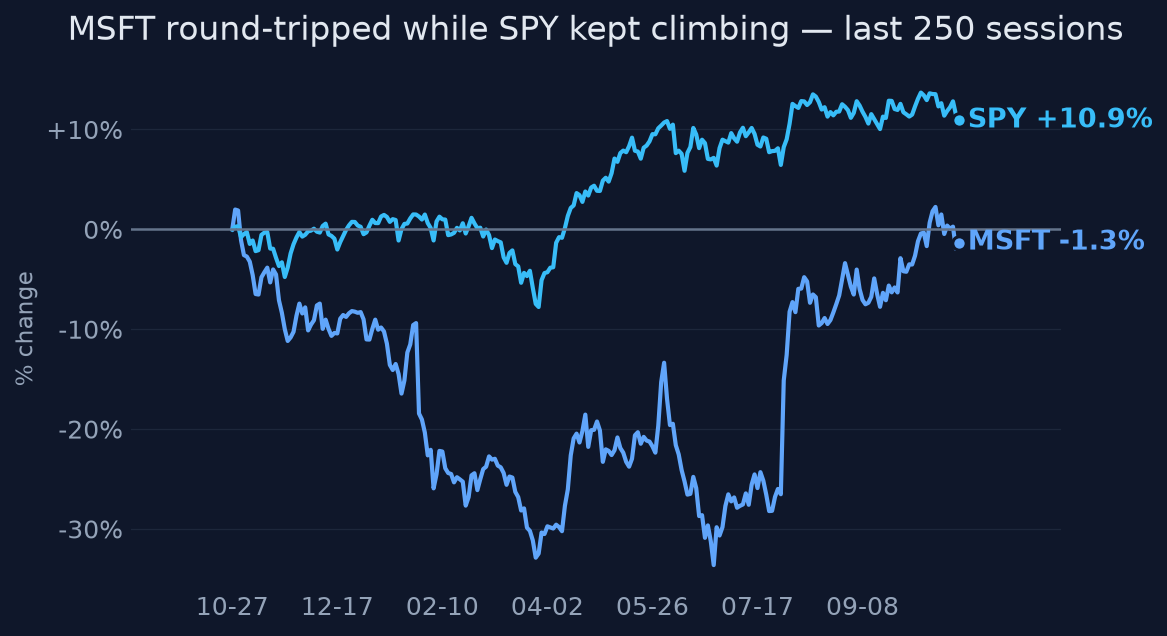
Since publication vs SPY · closed horizons are frozen
The full research everything the view rests on
Direct answer to the question asked
Where the edge would come from
What the price assumes
Current price (~$528) at ~25-26x FY27 EPS implies the market believes the growth algorithm (~16-18% revenue, broadly stable margins) but refuses to pay the FY23-25 premium of 32-35x until AI capex ROI is proven. Consensus FY27 revenue of $391B and EPS of $19.76 have been revised modestly upward (5 up / 0 down on FY27 EPS over 30 days), so the bar into Oct 28 is a clean Azure print near 40%+ and no negative surprise on FY27 capex/margin framing. Options-implied calm (20d realized vol at the 9th percentile of the past year) suggests the market is under-pricing the potential size of the post-earnings move.
Why the market may be wrong
Two ways. Bullish: the market may be over-weighting capex circularity risk while under-weighting that (a) operating margin EXPANDED to a record 46.8% in FY26 despite >$50B quarterly capex, (b) $678B RPO (+84%) and $250B OpenAI Azure commitment give multi-year visibility most cyclicals lack, and (c) the de-rating already happened — bad news is partly priced. Bearish: consensus may be under-weighting that FY26 Q2 bookings (+230%) were heavily driven by OpenAI/Anthropic commitments — demand that is financially entangled with the ecosystem funding it — and that two-thirds of capex is short-lived GPUs whose economic depreciation may bite FY27-28 margins harder than the <1pt guided pressure, especially with the convenient 15→25-year useful-life extension flattering reported numbers from FY27.
The one thing to watch
The variable to watch is not Azure growth — it is the gap between Azure growth and the depreciation trajectory of a capex base that is now two-thirds short-lived GPUs, and MSFT just lengthened building useful lives 15→25 years, which shifts the depreciation mix toward those fast-decaying assets. If reported cloud gross margin (currently 67%) keeps sliding while management extends asset lives, reported EPS overstates economic earnings and the 'cheap at 25x' framing is weaker than it looks; if cloud gross margin stabilizes on GPU efficiency gains, the bear case loses its only quantitative leg.
Key evidence (10)
- FY26 results (reported Jul 29, 2026, MSFT IR [T2]): revenue $331.8B (+18%), operating margin 46.8% (series high), net income $133.7B (+31%); Q4 beat on all lines with $90.0B revenue and Azure +41%
- Azure crossed $100B annual revenue; AI business surpassed $37B ARR (+123%); M365 Copilot >30M paid seats; commercial RPO +84% to $678B [T2, MSFT IR]
- Quarterly capex now >$50B vs ~$19.4B a year earlier; ~2/3 of FY26 capex in short-lived GPUs/CPUs; Microsoft Cloud gross margin fell to 67% in FY26 Q2 [T2/T3]
- FY26 Q2 commercial bookings +230%, driven partly by large OpenAI and Anthropic Azure commitments — the circularity question is live [T3]
- MSFT extended data-center/building useful lives 15→25 years effective FY27, claiming minimal FY27 impact [T2]
- Forward P/E ~25.4-26.5x FY27 consensus vs 32-35x in FY23-25 and 25.3x in FY22 [T4 aggregators — treat as directional]
- FY27 EPS consensus $19.76, FY28 $23.70; FY27 EPS revised from $19.44 to $19.74 over 90 days; 5 up / 0 down in last 30 days [T4]
- Price: +34.8% over 3 months but only +0.76% over 1 year with -34.9% max drawdown; SPY +13.8% 1y; 20d realized vol at 9th percentile of trailing year; 60d beta to SPY risen to 1.49 [quant analysis of price history]
- OpenAI restructuring: MSFT retains ~25% as-converted equity, 20% revenue share through 2030 (capped), IP license and $250B Azure commitment through 2032; exclusivity gone; FY26 OpenAI-related revenue $24.1B [T2, MSFT 10-K]
- Cloud growth ranking: Google Cloud ~82% (smaller base) > Azure ~41-43% > AWS ~37% [T3]
Catalysts and risks
Catalysts
- FY27 Q1 earnings Oct 28, 2026 — Azure growth print vs ~40% and FY27 capex/margin commentary are the swing factors
- Anthropic IPO process (S-1 filed Oct 26, 2026) — potential mark-up of MSFT's stake and validation of its Azure commitment
- FY27 Q2 earnings (~late Jan 2027) — first full quarter under new depreciation policy; cloud gross margin trend
- Any update on OpenAI revenue-share mechanics or new OpenAI cloud deals with competitors (tests the exclusivity loss)
- Hyperscaler capex guidance from GOOGL/AMZN/META earnings — sector-wide read-through on AI infrastructure ROI sentiment
Risks
- Azure deceleration below ~38% with simultaneous capex acceleration — the exact combination that caused the prior -35% drawdown
- Circularity unwind: if AI-lab funding conditions tighten, OpenAI/Anthropic Azure commitments underpinning the RPO backlog could be restructured or deferred
- Depreciation catch-up: short-lived GPU-heavy capex mix pressures FY27-28 gross margins beyond the guided <1pt
- Accounting credibility: the 15→25-year useful-life extension invites scrutiny if margins disappoint
- Loss of OpenAI exclusivity means the strongest AI model franchise can now distribute through AWS/Google
- Elevated beta (1.49 60d) means any macro/AI-sentiment shock hits MSFT harder than the index
What to watch
- Azure YoY growth and constant-currency growth on Oct 28 vs the ~40% line
- FY27 capex guidance framing: 'peaking/moderating' vs 'continued acceleration' language
- Microsoft Cloud gross margin percentage (67% in FY26 Q2) — the single number that arbitrates bull vs bear
- Commercial bookings/RPO composition: how much incremental growth is OpenAI/Anthropic vs diversified enterprise demand
- Copilot seat growth and per-seat ARPU disclosures
- FY27 EPS revision breadth in the 30 days after earnings
- Post-earnings vol behavior: current 9th-percentile vol compression implies a larger-than-usual move either way
Market snapshot when the call was made 2026-10-23
Price
| Return 1w | -0.9% |
| Return 1m | +5.3% |
| Return 3m | +34.8% |
| Return 6m | +23.5% |
| Return 1y | +0.8% |
| From 52-week high | -3.5% |
| Realized vol, 20d | 19.7% |
| SPY 3m / 1y | +2.8% / +13.8% |
| QQQ 3m / 1y | +3.3% / +16.3% |
Technicals
MSFT technicals as of 2026-10-23: last close $524.51; 20d SMA 526.70 (bullish); 50d SMA 508.43; 12d EMA 528.39; 26d EMA 521.09; RSI 14 49.6 (balanced); 20d vol 18.9%; volume x0.7 vs 20d avg
Verifier notes PASS
Weakly sourced
- 'Anthropic's S-1 (filed Oct 26)' is stated as fact in the bull case and catalysts, but the evidence marks it as press-reported (digest explicitly tags Anthropic valuation/S-1 items as [T3/T4], 'not confirmed filings'). Low materiality — it is a secondary catalyst, not load-bearing for the thesis — but it could be hedged as 'reportedly filed'.
- The ~40% Azure growth bar for Oct 28 and the '32-35x FY23-25 premium' rest partly on [T4] consensus aggregators, though the opinion itself flags this ('treat as directional'), which is adequate disclosure.
Corrections applied
- Optional: qualify the Anthropic S-1 reference as 'reportedly filed Oct 26 per press reports' rather than stating it as confirmed fact.
Sources (18 · T1 = primary filings)
- T2https://www.microsoft.com/en-us/investor/events/fy-2026/earnings-fy-2026-q4
- T2https://www.microsoft.com/en-us/Investor/earnings/default
- T2https://www.microsoft.com/en-us/investor/earnings/fy-2026-q3/performance
- T2https://www.microsoft.com/en-us/Investor/earnings/FY-2026-Q4/press-release-webcast
- T2https://www.microsoft.com/en-us/investor/earnings/fy-2026-q2/intelligent-cloud-performance
- T2https://www.microsoft.com/en-us/investor/events/fy-2026/earnings-fy-2026-q3
- T2https://www.microsoft.com/en-us/Investor/earnings/FY-2026-Q1/performance
- T2https://www.microsoft.com/en-us/Investor/earnings/FY-2026-Q2/performance
- T2https://www.microsoft.com/en-us/investor/earnings/fy-2026-q4/press-release-webcast
- T4https://techcrunch.com/2026/07/29/microsoft-logs-3-2b-from-anthropic-investment-but-openai-was-a-mixed-bag/
- T3https://www.cnbc.com/amp/2026/10/26/anthropic-ipo-live-updates-ai-s-1-filing.html
- T3https://www.cnbc.com/2026/07/29/microsoft-msft-q4-earnings-report-2026.html
- T3https://www.cnbc.com/2026/10/26/anthropic-ipo-live-updates-ai-s-1-filing.html?msockid=10f7de345b7965db1264c9ca…
- T2https://www.microsoft.com/investor/reports/ar26/index.html?msockid=23ff58e97f5d69110d084f147ef6688e
- T2https://www.microsoft.com/investor/reports/ar26/index.html?msockid=3e2f21d9e4816fdb0cd83627e5816e8d
- T3https://www.cnbc.com/2026/07/30/aws-earnings-q2-2026.html
- T2https://www.microsoft.com/en-us/investor/events/fy-2026/earnings-fy-2026-q2
- T3https://www.cnbc.com/2026/07/30/amazon-amzn-q2-earnings-report-2026.html
Earlier and later calls on MSFT
- Oct 5, 2026No evidence — no thesis.No clear edgeview changed
- Aug 14, 2026Yes fundamentally, but entry is stretched.Lean bullish
Want a fresh look at MSFT, or another name?
Queue a new deep-research run. Published to the feed when done.
Automated research opinion, published as-is on Oct 26, 2026. Not personalised advice. Figures use end-of-day closes.