Trajectory strong; don't chase here.
Thesis
Bull case
Steel-man: PLTR is the rare company accelerating at scale — +93% y/y on $8B revenue with 55% GAAP net margins, Rule of 40 of 155, and demand breadth across US commercial (+149%), US government (+90%), and sovereign AI. FY27 consensus (+49%) looks too low against a +134% US commercial FY26 guide and an accelerating raise cadence; another big Q3 raise forces estimates higher again. The stock has already undergone its multiple purge (down 48%, then -4.3% over 1y while peers rallied 75-107%), so much of the froth was wrung out; remaining short interest can fuel further squeeze-driven upside. Structural tailwinds — defense AI budgets, sovereign AI, the on-premise AI architecture moat — support years of compounding, and dips in this name have been persistently buyable.
Bear case
Steel-man: at ~50x FY26 sales and ~78x FY27 EPS, the price requires near-perfection for years; the stock itself proved the fragility by losing 48% this calendar year while the business accelerated. The current entry is the worst kind: after a +29.5% single-day spike, +34% in a month, RSI 79, ~109% realized vol, with partial squeeze attribution (T4, unverified) and momentum-driven marginal buyers. Sell-side consensus — which historically chases PLTR up — can only justify 5-16% upside. Insiders were selling hundreds of millions of dollars of stock in early 2026 (Thiel ~2M shares / ~$280M; Karp ~493K / ~$66M — T4-sourced totals, though consistent with long-running 10b5-1 programs). Eighty-one percent of revenue is US, government budget cycles turn, and the first quarter where the raise delta shrinks hits a 50x-sales multiple with 25-40% downside — asymmetric against a fresh entry.
What would change our mind
- For the cautious-entry view: if the stock consolidates sideways-to-down 15-25% while FY27 estimates continue rising, the asymmetry flips bullish and the 'wait' stance should convert to a buy
- For the bullish business view: if Q3 2026 shows US commercial growth decelerating well below the +134% FY guide trajectory AND the FY raise delta falls to <$200M, the hypergrowth thesis itself (not just the entry) is impaired
- If PLTR grinds to new highs on rising estimates with realized vol compressing below ~60%, the 'squeeze/momentum fragility' framing was wrong and staged entries would have outperformed waiting
- If government/semi-annual budget actions cut defense-AI program funding, the demand-durability assumption underpinning FY27 consensus is invalidated
Since publication vs SPY · closed horizons are frozen
The full research everything the view rests on
Direct answer to the question asked
Where the edge would come from
What the price assumes
At ~$405B market cap: ~50x FY26 consensus revenue ($8.19B), ~120x FY26 EPS ($1.46), ~78x FY27 EPS ($2.28). The price embeds sustained 40-50% growth through FY27 with continued beat-and-raise cadence and no multiple accident. Sell-side is chasing, not leading: post-Q2 targets (WSJ snapshot: median $205, avg ~$199; another snapshot avg ~$186, 'Moderate Buy') imply just 5-16% upside from $177, meaning even a bullish Street can't justify much more at this price.
Why the market may be wrong
Both directions are live. Consensus FY27 growth of ~49% may be too low — FY26 US commercial guidance alone implies +134%, and the raise cadence is accelerating, so bulls may be under-estimating compounding. Conversely, the market may be under-pricing de-rating risk: growth must eventually decelerate from 93% (base rates), 81% of revenue is US (government budget cyclicality), and the January-July 2026 drawdown showed the multiple can halve on sentiment alone. The most likely consensus error over 3-6 months is not on the revenue line but on the raise-magnitude assumption — the market now prices each quarter's guidance raise as structural rather than decelerating.
The one thing to watch
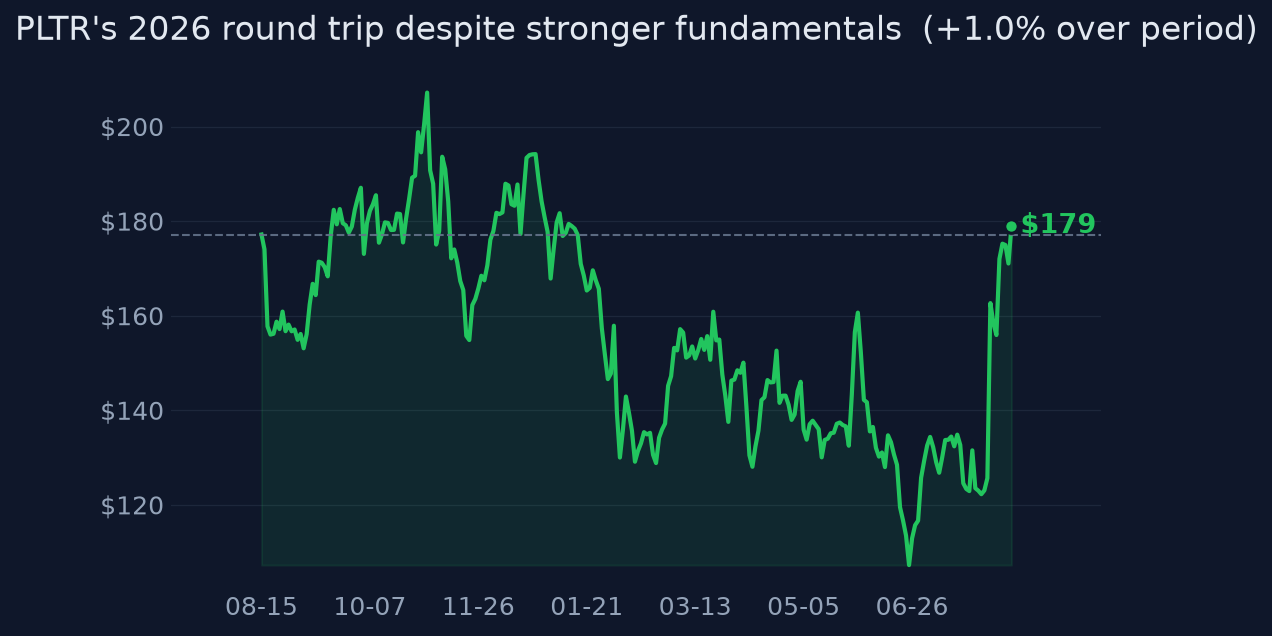
Stop watching the 93% growth rate — watch the guidance-raise delta. PLTR fell 48% in H1 2026 while growth accelerated from +85% to +93%, proving the stock prices the second derivative of guidance revisions, not the first derivative of revenue. Q2's FY26 raise was ~$490M ($7.66B → $8.15B, May 4 → Aug 3, Reuters). Falsifiable: if the Q3 print raises FY26 guidance by materially less than ~$400M — even on a revenue beat — expect a 20-30% de-rate, because that is the signal the beat-and-raise engine is decaying.
Key evidence (8)
- Q2 2026 (reported Aug 3, T1 IR/T2 Reuters): revenue $1.935B +93% y/y (accelerating from +85% in Q1), GAAP net income $1.06B (55% margin), adjusted FCF $1.22B, adj EPS $0.41 vs ~$0.35 expected
- Guidance raised twice in 2026: FY26 revenue to $8.15-8.16B (~+82%, 'largest-ever raise') from $7.65-7.66B guided May 4; Q3 guided $2.16B+; FY26 US commercial guide implies +134% [T1/T2]
- Consensus as of Aug 12-14, 2026 [T2/T3]: FY26 $8.19B rev / $1.46 EPS; FY27 $12.17B / $2.28 EPS — revised upward over 3 months
- Price action [computed from price history, Aug 13-14, 2026]: 1y return -4.3% with max drawdown -48.2% (52w range ~$107-207); +29.5% on Aug 4 (biggest day since Feb 2024, Reuters); +34% in 1 month; RSI 79; 20d realized vol ~109%; 13.6% below 52w high
- Valuation [computed]: ~$405B market cap ≈ 50x FY26 sales, ~120x FY26 EPS, ~78x FY27 EPS — down from far more extreme levels a year ago but still an outlier vs peers
- Street targets post-Q2 [WSJ snapshot, T3]: median $205, avg ~$199, high $255, low $80 vs $179 price — 5-16% consensus upside, very wide dispersion
- Anomaly to note: the -48% H1 2026 drawdown occurred while revenue growth accelerated — multiple compression with no fundamental deterioration
- Peer context [price data]: CRWD +107%, SNOW +75%, DDOG +96% over 1y vs PLTR -4.3%; C3.ai -39.8% (PLTR's competitive dominance is clear)
Catalysts and risks
Catalysts
- Q3 2026 earnings (~early November 2026): the pivotal in-window event — beat magnitude and especially the FY26 guidance-raise delta vs Q2's ~$490M
- Government contract announcements: Maven/Army expansions and allied sovereign-AI deals (recurring headline flow)
- US government appropriations/budget process for defense AI programs
- Estimate revision momentum for FY27 (currently $12.17B / $2.28 EPS) into year-end
- Preliminary FY27 outlook typically framed on the Q4 call (Feb 2027) — near the edge of the horizon
- Insider transaction filings (additional 10b5-1 sales are headline-negative at these valuations)
- Short interest data — confirmation/refutation of the claimed squeeze component (currently T4-only)
Risks
- Multiple compression: the H1 2026 drawdown (-48%) occurred with accelerating fundamentals; a repeat on any AI-sentiment reset is the dominant risk
- Raise-delta decay: the first quarter with a materially smaller guidance raise likely triggers de-rating even on a beat
- Growth deceleration from +93% is arithmetic inevitability; at this multiple the slope of decel, not its existence, is the risk
- Concentration: 81% of revenue from the US; government budget dependence; international growth (~30%+, thin data) materially slower
- Technicals/positioning: RSI 79, ~109% realized vol, squeeze-driven flows — high probability of sharp mean-reversion regardless of news
- Insider selling at scale provides a persistent 'why sell here?' overhang
- Evidence caveats: the $3B short-squeeze claim and insider-sale totals rest on T4 sources only; a garbled 'forward P/E low-200s at $500-600 stock price' claim in the research was discarded as stale
What to watch
- The Q3 FY26 guidance-raise delta vs Q2's ~$490M — the single most predictive variable for the stock
- US commercial y/y growth vs the +134% implied FY26 guide; US government growth vs +90%
- FY27 estimate revisions after Q3 (currently $12.17B / $2.28 EPS): rising estimates + flat stock = compression and improving entry; falling estimates + high price = exit signal
- Realized vol and RSI normalization — an overbought condition at 109% vol resolves violently more often than gently
- Short interest releases (verify/refute the squeeze narrative)
- Form 4 insider filings cadence from Karp/Thiel entities
- International segment growth detail in the Q3 10-Q (currently thin; US is 81% of revenue)
- Analyst target migration: the low end ($70-80) vs median ($205) spread indicates unresolved fundamental disagreement
Market snapshot when the call was made 2026-08-13
Price
| Return 1w | +14.8% |
| Return 1m | +33.8% |
| Return 3m | +37.6% |
| Return 6m | +31.9% |
| Return 1y | -4.3% |
| From 52-week high | -13.6% |
| Realized vol, 20d | 109.3% |
| SPY 3m / 1y | +4.8% / +21.0% |
| QQQ 3m / 1y | +2.4% / +26.2% |
Technicals
PLTR technicals as of 2026-08-13: last close $179.01; 20d SMA 143.45 (bullish); 50d SMA 134.35; 12d EMA 159.17; 26d EMA 146.90; RSI 14 79.1 (overbought); 20d vol 119.9%; volume x0.8 vs 20d avg
Sources (18 · T1 = primary filings)
- T3https://www.cnbc.com/2026/08/03/palantir-pltr-earnings-q2-2026.html
- T4https://finance.yahoo.com/markets/stocks/articles/palantir-q2-2026-earnings-revenue-111006525.html
- T2https://www.reuters.com/technology/palantir-raises-annual-revenue-forecast-strong-demand-us-government-commerc…
- T1https://investors.palantir.com/news-details/2026/Palantir-Reports-Q2-2026-U-S--Comm-Revenue-Growth-of-149-YY-a…
- T1https://investors.palantir.com/financials/quarterly-results
- T4https://www.marketbeat.com/earnings/reports/2026-8-3-palantir-technologies-inc-stock/
- T4https://api.finexus.net/api/trading/e4478ea7-b252-434e-8675-78a4e757abfa/html
- T2https://www.reuters.com/business/nasdaq-futures-underpinned-by-strong-ai-forecasts-focus-earnings-data-2026-08…
- T4https://www.techtimes.com/articles/323175/20260805/palantir-q2-2026-earnings-prove-premise-ai-thesis-3b-short-…
- T1https://investors.palantir.com/files/Palantir%20-%20Q1%202026%20Business%20Update.pdf
- T3https://www.cnbc.com/2026/08/04/palantir-2q-earnings-ai-sovereign-tools.html
- T4https://www.investing.com/news/company-news/palantir-q2-2026-slides-93-revenue-surge-ai-sovereignty-focus-93CH…
- T4https://x.com/algotradingdesk/status/2085967855003287850
- T4https://finance.yahoo.com/quote/PTX0.DU/earnings/PTX0.DU-Q2-2026-earnings_call-660319.html
- T4https://www.investing.com/news/transcripts/earnings-call-transcript-palantir-tops-q2-2026-forecasts-shares-jum…
- T4https://247wallst.com/investing/2026/08/04/after-palantirs-blowout-earnings-heres-where-the-stock-could-head-n…
- T4https://www.msn.com/en-us/money/general/palantir-q2-2026-earnings-prove-on-premise-ai-thesis-with-3b-short-squ…
- T4https://www.theglobeandmail.com/investing/markets/stocks/PLTR/pressreleases/3767775/palantir-pltr-q2-2026-earn…
Earlier and later calls on PLTR
- Oct 15, 2026Real fundamentals, stretched entry.No clear edge
- Aug 14, 2026Great company, bad entry price.No clear edge
Want a fresh look at PLTR, or another name?
Queue a new deep-research run. Published to the feed when done.
Automated research opinion, published as-is on Aug 14, 2026. Not personalised advice. Figures use end-of-day closes.