Yes — value is emerging here.
Thesis
Bull case
Fundamentals (bookings +22%, 35% non-GAAP EPS growth, >$10B FCF, rising estimates) never broke while the multiple compressed ~40 points relative to SPY. The AV spend is staged and milestone-linked, so FCF likely holds near-term; the ~6.5% FCF yield provides valuation support, and IF buybacks are maintained alongside the staged AV spend they would reinforce the floor — though buyback pace is unconfirmed and is itself a key watch item. Tesla robotaxi execution stumbles and Uber's multi-partner model (Rivian, others) preserve its role as the distribution layer even post-Waymo. A solid Q3 print (~Nov) showing intact FCF could trigger re-rating from ~16x FY27 toward prior multiples.
Bear case
Waymo — the only scaled AV operator — is actively disintermediating Uber (Phoenix exit June 2026, own-app launch in Austin/Atlanta Jan 2028), validating that the demand-aggregation layer is not Uber's to keep. The $10B+ commitment structurally raises capital intensity, likely crowds out buybacks, and has already produced two consecutive below-consensus EPS guides; each new AV partnership announcement may pressure margins further. If the market is pricing a permanent FCF haircut rather than transient fear, ~16x FY27 is not obviously cheap. Guidance credibility is damaged — the pattern is beat-and-guide-down.
What would change our mind
- TTM FCF falls meaningfully below ~$9B over the next two quarters with AV capex cited as cause — confirms the market's FCF-haircut thesis
- A second major AV partner follows Waymo to direct-to-consumer distribution, or Tesla robotaxi reaches broad multi-city scale with reliable service
- FY2027 consensus EPS (~$4.64) starts being cut — converts this from multiple compression into estimate deterioration
- Buybacks are explicitly cut/suspended to fund AV at the next print
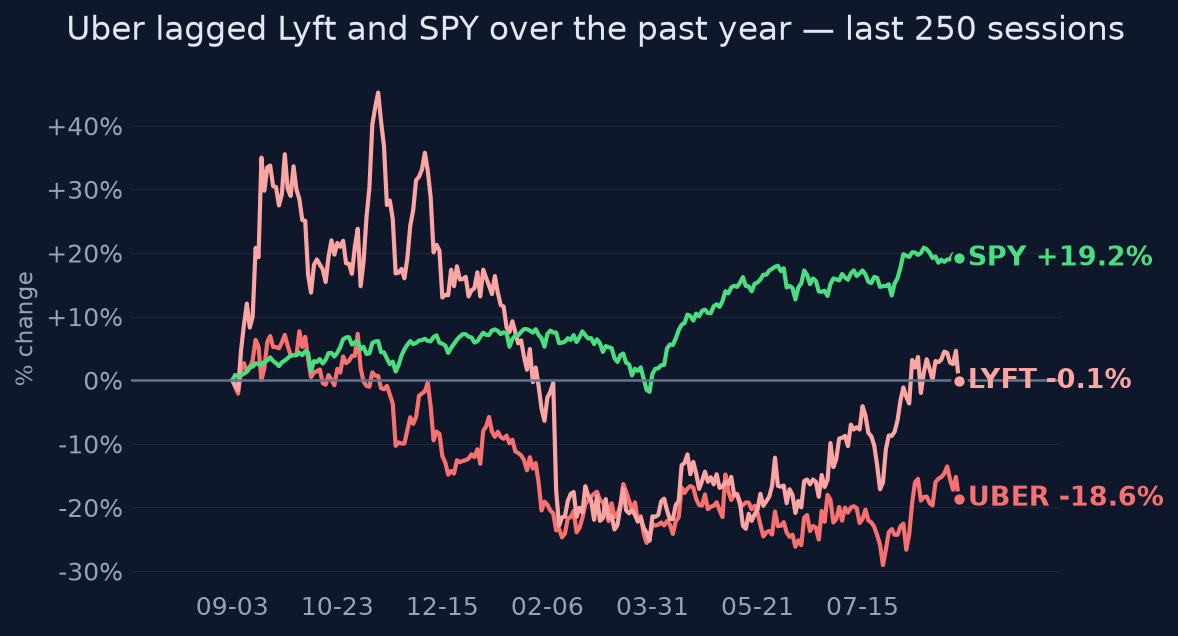
Since publication vs SPY · closed horizons are frozen
The full research everything the view rests on
Direct answer to the question asked
Where the edge would come from
What the price assumes
At ~$75.65 against consensus FY26 EPS ~$3.29 and FY27 ~$4.64, the stock trades at roughly 23x FY26 / ~16.3x FY27 (note: a widely cited stockanalysis [T4] snapshot shows 22.5x/15.4x, but that pair rests on a different estimate set of $3.13/$4.56 and a lower implied price — it is not derivable from the current consensus and should not be mixed with it). With ~6.5% TTM FCF yield on ~$153B market cap, the market appears to price meaningful FCF drag from the AV buildout and eventual take-rate compression — i.e., it does not believe the $10B+ FCF run-rate survives the transition. Estimates themselves have been revised UP (FY26 EPS $2.95→$3.29 over summer), so the derating is multiple compression, not estimate cuts.
Why the market may be wrong
Two-sided. Bullish case for mispricing: the commitments are staged and milestone-linked ($300M initial Rivian tranche vs $1.25B through 2031), so the FCF hit is phased, not abrupt — each quarter of intact FCF forces reassessment. Bearish counter: the market may be correctly pricing that (a) Waymo's move to its own app by Jan 2028 in Austin/Atlanta and the Phoenix exit show the best AV operator is disintermediating Uber, and (b) the $10B commitment directly competes with buybacks that previously supported the stock — and buyback pace under the new capital plan is an unconfirmed unknown, so the 'yield support' leg of the bull case is weaker than it looks.
The one thing to watch
The decisive fact is that LYFT outperformed UBER by ~26 points over the past year while AV fear supposedly crushed the sector — the market is not shorting ride-hailing or AV disruption, it is specifically penalizing Uber's choice to fund the AV transition with its own balance sheet. That means the variable to watch is quarterly FCF and buyback activity, not bookings or AV headlines: if FCF holds while capex stays staged, the selloff unwinds; the first quarter FCF dips materially is the market's thesis confirmed.
Key evidence (9)
- Q2 2026 (Aug 5, 2026, SEC [T1]): revenue $14.19B (+12% YoY), gross bookings ~$58B (+22% YoY, above guidance high end), adj. EPS $0.81 vs $0.80 est., TTM FCF >$10B — 4th straight quarter of >20% bookings growth
- Q3 2026 guidance (Aug 5, 2026, Reuters [T2]): EPS $0.84–0.88 vs ~$0.89 consensus — the immediate selloff trigger, attributed to AV investment scaling
- Consensus revised upward (MarketWatch [T3]/stockanalysis [T4]): FY26 EPS ~$3.29 (from ~$2.95 mid-July), FY27 ~$4.64; at $75.65 that implies ~23x FY26 / ~16.3x FY27. The alternately cited 22.5x/15.4x pair comes from a stockanalysis [T4] snapshot using different estimates ($3.13/$4.56) and a lower price — the two sets are not interchangeable
- Uber–Rivian partnership (2026, IR [T1]): up to $1.25B investment through 2031, $300M initial, up to 50,000 R2 robotaxis (10K initial + 40K option from 2030)
- Uber commits >$10B to robotaxis (Apr 15, 2026, FT/Reuters [T2]): ~$2.5B+ equity stakes + ~$7.5B+ fleet/vehicle commitments; the associated ~120K-vehicle deployment ambition is partly [T4]-sourced and unverified — treat as directional, not contractual
- Waymo notified Uber it will launch via its own app in Austin and Atlanta in Jan 2028, ending exclusivity (Jul 2026, Reuters/Bloomberg [T2]); Phoenix tie-up ended June 2026 [T2]
- Tesla robotaxi expanding but with slow rollout/execution issues (2026, Reuters [T2]) — not yet at disintermediating scale
- 2026 effective tax rate guided up to 22–25% (Feb 4, 2026, Reuters [T2])
- LYFT +4.7% vs UBER -21.2% over 1y (computed from daily price history) — sector-level AV fear is not the repricing driver
Catalysts and risks
Catalysts
- Q3 2026 earnings (~early Nov 2026): FCF print vs $10B TTM run-rate; capex/AV spend disclosure; buyback pace
- Announcement of Phoenix AV partner replacement (teased by Bloomberg, June 2026)
- Further details/schedule on the $10B AV commitment phasing
- Tesla robotaxi expansion pace and safety incidents through year-end
- Waymo city launches and any signal on whether remaining Uber-Waymo cooperation survives
- FY2027 guidance at Q4 print (Feb 2027) — first full read on AV-era margins
Risks
- FCF deterioration as AV commitments convert from staged promises to actual outlays
- Buybacks quietly reduced or suspended to fund AV — currently unconfirmed and would remove a presumed valuation support
- Additional AV operators (beyond Waymo) choosing direct-to-consumer distribution over Uber
- Q3 EPS guide already below consensus — a miss on even the lowered bar compounds credibility damage
- Higher 22–25% tax rate structurally caps EPS conversion
- Regulatory/liability events around robotaxi partners could freeze deployment and strand committed capital
- Macro softness in consumer mobility demand given 47% realized vol and beta 1.15
What to watch
- Quarterly FCF and capex line — the single variable that resolves the thesis (not bookings)
- Share repurchase pace in Q3/Q4 prints — unconfirmed today and central to whether the ~6.5% FCF yield translates into per-share support
- Waymo's execution in its own app in new cities and any renegotiation signals before Jan 2028
- Lyft's relative performance as a live control group for sector vs strategy repricing
- Tesla robotaxi wait times/expansion cadence as reported by Reuters
- Whether Uber discloses a formal capex schedule for the $10B commitment
Market snapshot when the call was made 2026-08-31
Price
| Return 1w | -4.6% |
| Return 1m | +7.5% |
| Return 3m | +2.5% |
| Return 6m | -0.4% |
| Return 1y | -21.2% |
| From 52-week high | -24.4% |
| Realized vol, 20d | 47.2% |
| SPY 3m / 1y | +1.1% / +18.2% |
| QQQ 3m / 1y | -3.5% / +24.2% |
Technicals
UBER technicals as of 2026-08-31: last close $75.65; 20d SMA 76.20 (bullish); 50d SMA 73.77; 12d EMA 77.22; 26d EMA 75.78; RSI 14 42.5 (balanced); 20d vol 47.3%; volume x0.9 vs 20d avg
Verifier notes REVISE · opinion revised once
Unsupported claims
- Bull case states 'buybacks plus a ~6.5% FCF yield support the floor' — the evidence bundle contains no confirmation of ongoing buyback pace; the planner digest explicitly lists 'whether buybacks are being cut to fund AV' as an unconfirmed unknown, and the deal-terms research suggests capital is being redirected AWAY from repurchases. Presenting continuing buybacks as a support is asserted, not evidenced.
Weakly sourced
- The forward multiples '22.5x FY26 / 15.4x FY27' rest on the stockanalysis [T4] snapshot whose underlying EPS estimates ($3.13/$4.56) differ from the $3.29/$4.64 consensus the opinion cites in the same sentence — the multiples are not derivable from the opinion's own stated inputs and appear to be a stale snapshot from a lower price (~$70).
- '120K vehicles ambition' is correctly hedged as partly [T4]-sourced; acceptable, but it recurs in the thesis-adjacent framing and should stay clearly flagged as unverified.
Internal inconsistencies
- Valuation math does not reconcile: at the stated ~$75 price with the cited FY26/FY27 EPS of $3.29/$4.64, the multiples are ~22.8x / ~16.2x — not the '22.5x / 15.4x' stated in market_expectation nor the '~15x FY27' anchor used in direct_answer, thesis, and bear_case. The 15.4x figure comes from an alternate snapshot with different EPS ($4.56) and a lower implied price; the opinion mixes two estimate sets as if they were one, overstating cheapness by roughly one turn on FY27.
Corrections applied
- Recompute multiples from the opinion's own inputs: at $75.65 and consensus $3.29/$4.64, state ~23x FY26 / ~16.3x FY27 (or explicitly attribute the 22.5x/15.4x pair to the stockanalysis snapshot with its $3.13/$4.56 estimates and note the price has since risen). Replace the repeated '~15x FY27' anchor with '~16x FY27' in direct_answer, thesis, market_expectation, and bear_case.
- Soften the bull-case buyback claim to reflect the evidence: e.g., 'IF buybacks are maintained alongside the staged AV spend, they plus the ~6.5% FCF yield would support the floor — but buyback pace is unconfirmed and is itself a key watch item' (the opinion already lists buyback cuts as a risk/invalidation condition, so this aligns the bull case with the rest of the document).
Sources (29 · T1 = primary filings)
- T4https://techcrunch.com/2026/02/04/uber-appoints-new-cfo-as-its-av-plans-accelerate/
- T1https://investor.uber.com/news-events/news/press-release-details/2026/Uber-and-Rivian-Partner-to-Deploy-up-to-…
- T2https://www.reuters.com/business/autos-transportation/tesla-rolls-out-robotaxi-service-miami-2026-07-03/
- T4https://www.matterfact.com/newsletter/2026-04-19-uber-10b-autonomy-pivot
- T2https://www.reuters.com/business/davos/davos-musk-expects-europe-china-approve-teslas-fsd-system-next-month-20…
- T4https://theroboticsmedia.com/article/uber-10-billion-autonomous-vehicle-commitment-q2-2026-earnings-120k-vehic…
- T2https://www.reuters.com/business/autos-transportation/musk-sounds-cautious-tone-robotaxis-amid-slower-than-exp…
- T2https://www.reuters.com/business/autos-transportation/tesla-rolls-out-unsupervised-robotaxis-austin-2026-06-03…
- T2https://www.reuters.com/business/autos-transportation/uber-forecasts-weak-quarterly-profit-doubles-down-robota…
- T2https://www.reuters.com/business/autos-transportation/uber-forecasts-profit-below-estimates-cheaper-rides-boos…
- T4https://www.theglobeandmail.com/investing/markets/stocks/UBER/pressreleases/3809164/uber-uber-q2-2026-earnings…
- T4https://fortune.com/company/uber-technologies/earnings/q2-2026/
- T4https://ca.investing.com/news/company-news/uber-technologies-inc-uber-q2-2026-earnings-call-highlights-record-…
- T3https://www.cnbc.com/2026/08/05/uber-stock-q2-2026-earnings.html
- T4https://www.investing.com/news/transcripts/earnings-call-transcript-uber-q1-2026-sees-strong-growth-stock-rise…
- T4https://fintel.io/doc/sec-uber-technologies-inc-1543151-10k-2026-february-13-20497-285
- T2https://www.reuters.com/business/waymo-explores-ending-uber-partnership-financial-times-reports-2026-07-24/
- T4https://www.automotiveworld.com/news/uber-confirms-end-of-tie-up-with-waymo-as-rivalry-heats-up/
- T2https://www.bloomberg.com/news/articles/2026-07-24/waymo-explores-exit-from-uber-robotaxi-partnership-ft-says
- T2https://www.bloomberg.com/news/articles/2026-06-29/uber-waymo-have-ended-robotaxi-tie-up-in-phoenix-uber-to-an…
- T3https://www.cnbc.com/2026/07/24/uber-and-waymo-to-end-exclusivity-arrangement-in-atlanta-and-austin.html
- T4https://www.latimes.com/business/story/2026-08-04/waymo-rift-leaves-ubers-robotaxi-ambitions-on-shaky-ground
- T4https://en.sedaily.com/international/2026/07/27/waymo-ends-uber-partnership-after-three-years-plans-solo
- T3https://www.cnbc.com/video/2026/07/24/waymo-reportedly-weighing-ending-uber-partnership.html
- T2https://www.reuters.com/business/uber-commits-10-billion-robotaxis-strategy-shift-ft-says-2026-04-15/
- T4https://money.usnews.com/investing/news/articles/2026-04-15/uber-commits-10-billion-to-robotaxis-in-strategy-s…
- T4https://www.investing.com/news/stock-market-news/uber-commits-10-billion-to-robotaxis-in-strategy-shift-ft-say…
- T4https://www.wionews.com/world/uber-built-an-empire-on-not-owning-cars-it-s-about-to-buy-120-000-of-them-178619…
- T4https://avmarketstrategist.substack.com/p/uber-q22026-10-billion-av-investment
Earlier and later calls on UBER
- Oct 18, 2026Yes — derating looks overdone.Lean bullish
- Oct 6, 2026Derated, not deteriorating — lean bullish.Lean bullish
- Aug 9, 2026Not immediately; strategically, yes.Lean bullish
Want a fresh look at UBER, or another name?
Queue a new deep-research run. Published to the feed when done.
Automated research opinion, published as-is on Sep 1, 2026. Not personalised advice. Figures use end-of-day closes.